
If your home sits on an unadopted road in Scotland, you may have heard that it can make a sale harder, or that you could be landed with a big repair bill one day. Both worries are understandable, but the reality is usually far less dramatic once you know what the law says and what your title deeds actually contain.
The short answer is that you can absolutely sell a house on an unadopted road in Scotland. The council simply does not maintain the road, so buyers, their solicitor and their lender will want clear answers on three things: your legal right of access, who pays for upkeep, and the current condition of the surface.
Key points at a glance
- Unadopted means private: the road is not on the council’s list of public roads, so the council has no duty to maintain it under the Roads (Scotland) Act 1984.
- Your deeds decide who pays: maintenance is normally governed by real burdens or other title conditions shared between the owners who use the road.
- The council can step in: it can serve notice on frontagers to bring a private road up to a reasonable standard and recover the cost from them.
- Checking is simple: the council’s list of public roads and the roads section of a property enquiry certificate (PEC) show whether the road is adopted.
- Access must be secure: buyers and lenders want a clear servitude right of access or ownership of the road, plus sensible maintenance arrangements.
- It is rarely a deal breaker: good paperwork and early preparation usually keep a sale on track.
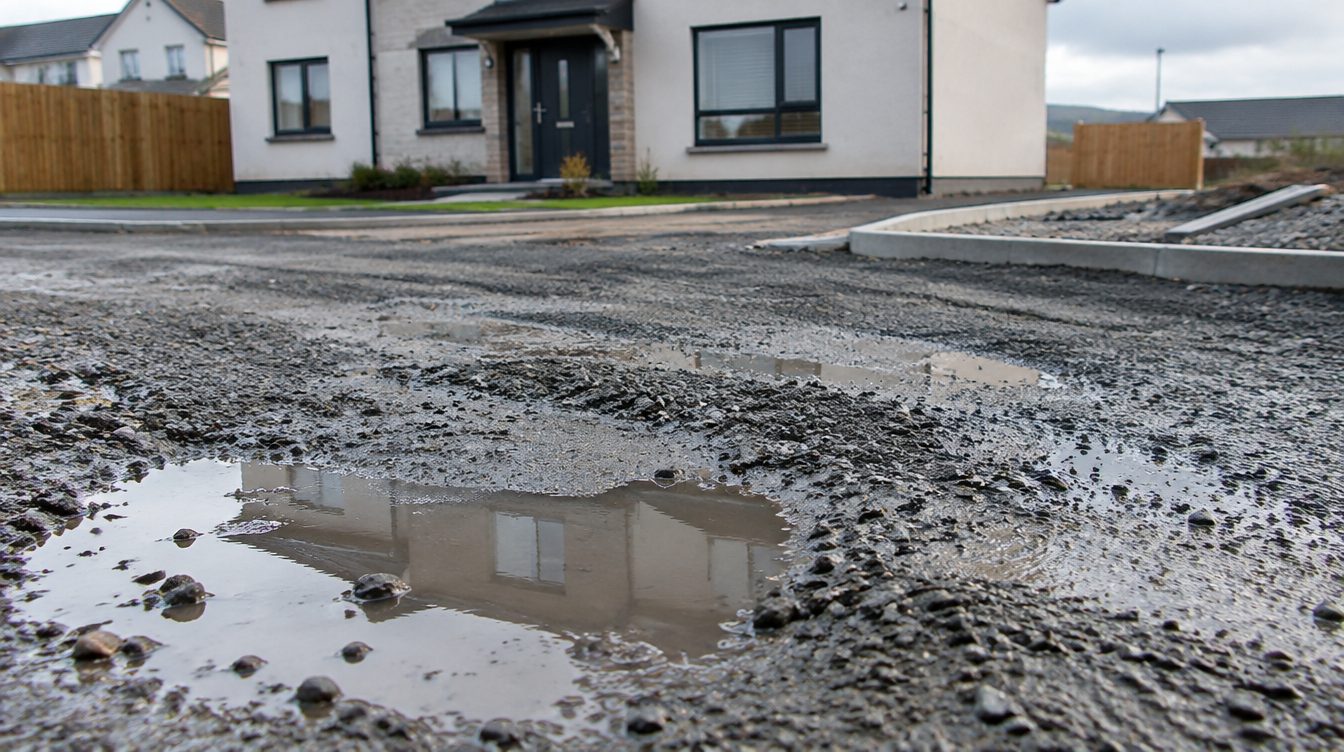
What is an unadopted road in Scotland?
Under the Roads (Scotland) Act 1984, every local roads authority (your council) must keep a list of public roads for its area and must manage and maintain every road on that list. A road that is on the list has been “adopted”. Any road that is not on the list is, in the words of the Act, a private road. In everyday language, “unadopted road” and “private road” mean the same thing.
The Act defines a road as any way over which there is a public right of passage. That means a private road can still be used by the public, by bin lorries and by delivery drivers. Unadopted simply means the council is not responsible for repairing it.
Common examples of unadopted roads
- New build estates: roads built by a developer that have not yet been added to the list of public roads.
- Rural lanes and farm tracks: access roads serving cottages, steadings and converted farm buildings.
- Old estate roads: roads created by a landed estate, often still owned by the estate or a successor company.
- Shared private accesses: short roads or driveways serving a handful of houses, which are often the subject of disputes over shared driveways.
Who is responsible for maintaining an unadopted road?
A common belief is that the Roads (Scotland) Act 1984 automatically makes the people whose properties front the road responsible for its upkeep. That is not quite right. The Act gives the council powers over private roads, but day to day responsibility for repairs normally comes from your title deeds and from who owns the road itself.
What your title deeds may say
Most modern titles, and many older ones, contain real burdens setting out who must maintain the road and how the cost is split. The Title Conditions (Scotland) Act 2003 specifically lists a private road as an example of a shared “facility” that can be the subject of a maintenance burden. Typical arrangements include:
- Equal shares: each house served by the road pays the same proportion of repair costs.
- Shares by use or frontage: owners pay more or less depending on how much of the road they use or border.
- A deed of conditions: on newer estates, a single deed often sets out maintenance of roads, footpaths, lighting and open space, sometimes managed by a factor.
- Ownership of the road surface: the road may be owned in common by the neighbours, split into strips owned by each house, or retained by a developer, estate or other landowner.
What happens if the deeds say nothing?
Where the titles are silent, the position depends on who owns the road and what rights each household holds. If you only have a servitude right of access over someone else’s land, the landowner is generally not obliged to keep the road in repair for you, although you are usually entitled to carry out the repairs needed to use it. Where neighbours own the road together, the general rule is that necessary repairs are shared, but this is an area where disagreements are common. Your solicitor can explain how the rules apply to your particular title.
What can the council do about a private road?
Even though the council does not maintain a private road, the Roads (Scotland) Act 1984 gives it several powers that owners should know about:
- Notice to make up and maintain (section 13): the council can serve notice on the frontagers (the owners of land fronting or abutting the road) requiring them to bring the road up to a reasonable standard and keep it there. The work can include levelling, paving, lighting and drainage.
- What the notice must contain: the council’s estimate of the cost, a scheme setting out how the cost is split between frontagers, and the dates for starting and finishing the work.
- If the work is not done: the council can carry out the work itself and recover the cost from the frontagers in line with the scheme. Anyone served with a notice can appeal to the sheriff within 28 days.
- Discretionary help (section 14): the council may contribute towards the cost of making up or maintaining a private road, or carry out repairs at its own expense. Doing so does not make it responsible for the road in future.
- Emergency work (section 15): in an emergency the council can carry out work on a private road at its own expense.
| Who | Typical role on an unadopted road |
|---|---|
| Council (local roads authority) | No duty to maintain. Can require frontagers to make up the road, carry out emergency work, contribute at its discretion and adopt the road once it meets the required standard. |
| Owners named in the title deeds | Share the cost of repairs, resurfacing, drainage and sometimes lighting, in the proportions set out in the real burdens or deed of conditions. |
| Owner of the road surface | May be the neighbours, a developer, an estate or another landowner. Owns the ground, subject to any servitude rights held by others. |
| Developer (new build estates) | Builds the road under a road construction consent, lodges a road bond and is expected to bring the road up to standard and apply for adoption. |
How do I find out whether my road is adopted?
It is worth checking the status of your road before you put your home on the market, rather than waiting for the buyer’s solicitor to raise it. These are the main ways to find out:
- Check the list of public roads: every council must keep its list of public roads open for inspection free of charge. Many councils publish it online or will confirm the status of a street if you contact the roads department.
- Order a property enquiry certificate: a PEC is a council report used in conveyancing. Its roads section confirms whether the carriageway and footways next to the property are adopted and maintained by the council, and notes any proposed road schemes. Your solicitor will normally order one as part of the sale.
- Read the title sheet: your title on the Land Register of Scotland will show any rights of access and maintenance burdens, and whether you own any part of the road.
- Look at your Home Report: the surveyor may note that the road is unadopted, or recommend that your solicitor checks its status. Our guide to the Scottish Home Report explains what the surveyor covers.
- Ask the developer: on a newer estate, ask whether the roads have a construction consent and road bond, and when the developer expects to apply for adoption.
Good to know: adoption is not always all or nothing. The carriageway may be adopted while a footway, verge, turning head or the last few metres outside your house are not. Ask your solicitor to confirm that the whole route from your boundary to the public road is either adopted or covered by a clear right of access.
How do road bonds and adoption work on new developments?
On a new housing development, the developer needs a road construction consent from the council before building a new road. Under section 17 of the Roads (Scotland) Act 1984 and the Security for Private Road Works (Scotland) Regulations 1985 (as amended in 1998), the developer must also lodge a road bond or other security with the council before building homes that will be served by the road. Some bodies, such as councils and certain housing associations, are exempt.
The bond is there to protect homeowners. If the developer does not finish the road to the agreed standard, the council can step in, complete the work and use the bond to pay for it. Council guidance shows that bonds normally cover the carriageway, footways, verges, street lighting and road drainage, and are released in stages as the work progresses, with part of the security usually kept back until the road is adopted or the maintenance period ends.
How a road becomes adopted
- New roads: once the road is completed in line with its construction consent, the developer applies to the council, which must add it to the list of public roads within 12 months, provided it still meets the required standard.
- Existing private roads: the frontagers can apply for adoption. If the road meets the standard required by the council and the application is made by the requisite number of frontagers (a majority, or owners of at least half of the road frontage), the council must add it to the list within 12 months.
- Disputes: disagreements about whether a road meets the standard are settled by an arbiter.
What access rights do you need over a private road?
Living beside a road does not automatically give you a legal right to drive along it. If you do not own the road, you need a servitude right of access, which is a right over someone else’s land that benefits your property and passes to each new owner. On most modern estates this is written into the titles. With older rural properties the position can be less tidy.
- Express servitudes: rights granted in a deed, ideally describing the route and the type of use allowed (for example, vehicular and pedestrian access).
- Servitudes by long use: under the Prescription and Limitation (Scotland) Act 1973, a servitude that has been exercised openly and peaceably, without challenge in court, for 20 years becomes exempt from challenge. Proving it may need evidence such as statements from long standing residents.
- Gaps in the title: if the route is missing or unclear, the fix may be a new deed of servitude from the landowner or, in some cases, title indemnity insurance. Some lenders will not accept indemnity insurance in place of proper rights, so check with your solicitor early.
How does an unadopted road affect selling your house?
An unadopted road does not make a property unsellable. Many Scottish homes, from Highland cottages to new estates on the edge of our towns and cities, sit on private roads. What matters is how clear the paperwork is and how good the road looks when buyers arrive.
What buyers worry about
Buyers usually want to know what they might have to pay in future, whether the neighbours get on, and whether the road will cope with winter weather. A well kept lane with an agreed maintenance arrangement may barely affect interest. A road full of potholes, or one with an ongoing neighbour dispute, is one of the factors that can reduce the value of a house in Scotland and invite lower offers.
What lenders look for
Mortgage lenders instruct the buyer’s solicitor through the UK Finance Mortgage Lenders’ Handbook, which includes specific questions for Scotland about roads that are not adopted. Lender requirements vary. Some simply want the buyer told about their potential liability, while others require unrestricted rights of access, suitable maintenance arrangements, or no current disputes. If these points are not covered, the lender may ask questions, delay the offer of loan or decline, which is one reason a buyer’s mortgage application can be declined late in the process.
| Issue | Why it matters to a buyer | What helps |
|---|---|---|
| Road not on the list of public roads | The buyer will share future repair costs | Clear title burdens showing each owner’s share |
| No express right of access | Lender may refuse to lend | Deed of servitude or evidence of long use |
| Poor road surface | Buyers expect a repair bill and offer less | Quotes, repair history or an agreed plan with neighbours |
| New estate road awaiting adoption | Buyer wants assurance the road will be finished | Confirmation of construction consent and road bond |
Good to know: be open about any problems with the road. Hiding a known dispute or an outstanding council notice can cause serious trouble later. Our guide on what sellers have to disclose in Scotland explains the general position, but your solicitor should advise on your own circumstances.
How can you prepare to sell a house on an unadopted road?
- Speak to your solicitor early: ask them to review your title for access rights, ownership of the road and maintenance burdens before you list the property.
- Order the PEC promptly: knowing the official road status early avoids surprises during missives.
- Gather your records: keep invoices for past repairs, any written agreement between neighbours and details of any factor. These sit well alongside the other documents you need to sell a house in Scotland.
- Check other private services: homes on private roads often also have private drainage or water. If yours does, read our guides on selling a house with a septic tank and selling a property with a private water supply.
- Tidy up the approach: filling potholes or clearing drainage ditches, ideally with the neighbours, can make a big difference to first impressions.
- Allow extra time: unusual title issues can add weeks to a traditional sale, so plan around realistic expectations of how long it takes to sell a house in Scotland.
Can a cash buyer help if the road is putting buyers off?
If your road is in poor condition, the titles are complicated, or a previous buyer has already pulled out, selling to a cash buyer can be a practical alternative. A cash purchase does not depend on a mortgage lender’s requirements, and there are no viewings or chains to manage. Sell My House Fast in Scotland buys properties in all kinds of situations, including homes on private roads and rural tracks, and you can choose a date of entry that suits you.
A cash offer will reflect the property as it stands, so it is worth understanding why cash buyers often pay less than full market value and weighing that against the time, cost and uncertainty of fixing the road first. If you go ahead, our guide on what happens after you accept a cash offer explains the next steps. Similar access and title questions also come up with rural properties with an agricultural occupancy condition.
Frequently asked questions
Can the council force me to pay for repairs to a private road?
It can. Under section 13 of the Roads (Scotland) Act 1984, the council can serve notice on frontagers requiring them to make up and maintain the road to a reasonable standard, with the cost split under a scheme set out in the notice. You can appeal to the sheriff within 28 days of the notice being served.
Will my council adopt our road if we ask?
Only if the road meets the council’s adoptable standard and the application is made by the requisite number of frontagers. Bringing an older road up to that standard can be costly, and the owners usually pay. Contact your council’s roads department to ask what standard applies.
What if a neighbour refuses to pay their share of road repairs?
If your titles contain a maintenance burden, the other owners can usually enforce it, but court action is a last resort. Start with a clear written proposal and quotes, and ask your solicitor about your options if that fails.
Worried your unadopted road will hold up your sale?
Sell My House Fast in Scotland can make a no obligation cash offer on homes on private and unadopted roads, with no viewings, no chain and a date of entry that suits you.
