
If you own a flat in a clad block in Scotland, you may have found that buyers, surveyors and mortgage lenders all start asking questions you cannot easily answer. Is the cladding safe? Is there an EWS1 form? Has the building had a Single Building Assessment? Who will pay if works are needed? It is easy to feel stuck.
The short answer is yes, you can sell a flat with cladding issues in Scotland. There is no legal bar to selling, and Scotland does not require an EWS1 form by law. The real challenge is that a buyer’s lender may not lend, or the valuer may not give a full value, until there is clear information about the external walls. This guide explains how the Scottish system works in 2026, how it differs from England, and the practical routes to a sale.
Key points at a glance
- Selling is allowed: cladding does not stop you selling, but it can limit who can buy with a mortgage.
- EWS1 is not a legal requirement in Scotland: it is an industry form, and the Scottish Government does not issue or endorse it.
- The Single Building Assessment is the Scottish route: it looks at the whole building, not one flat at a time.
- New law since January 2025: the Housing (Cladding Remediation) (Scotland) Act 2024 created the Cladding Assurance Register and powers to assess and fix buildings.
- Scotland is different from England: the leaseholder protections in the Building Safety Act 2022 do not apply to Scottish flat owners.
- A cash buyer removes the lender: no mortgage valuation means no EWS1 or lender sign off is needed to complete.
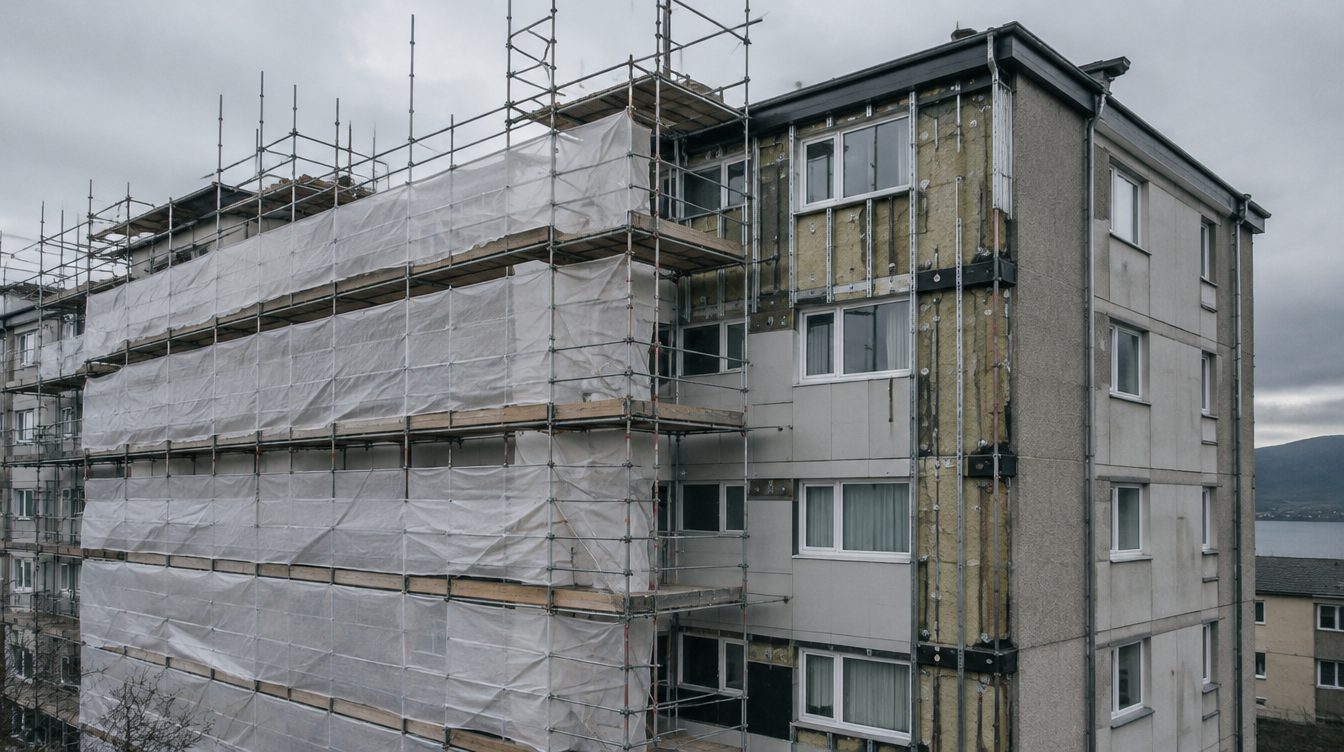
Why do flats with cladding cause problems when you sell?
After the Grenfell Tower fire on 14 June 2017, lenders and valuers across the UK became much more cautious about blocks of flats with external wall cladding. Some cladding materials were found to be highly flammable and could help a fire spread quickly. A lender needs to know the building is safe and that the flat will hold its value, so many began asking for evidence about the external wall system before lending.
Scotland has an extra complication. Flats here are usually owned outright by each owner, with shared ownership of common parts, rather than leased from a single freeholder. That meant the industry’s EWS1 process, which was designed around one building owner, often ended up being needed flat by flat. The Scottish Government recognised this problem, which is one reason it developed its own whole building approach.
What is an EWS1 form?
The EWS1 (External Wall System) form was created by the Royal Institution of Chartered Surveyors (RICS), UK Finance and the Building Societies Association so that valuers could value flats in buildings with cladding. It records a qualified professional’s opinion on the external walls. It is not a government or legal requirement, and it is not a fire safety certificate. It is valid for up to five years from the date it is signed.
The form has two main options, each with a rating:
| EWS1 rating | What it means | Likely effect on a sale |
|---|---|---|
| A1, A2 | External wall materials are unlikely to support combustion, and no remedial works to attachments such as balconies are needed. | Usually reassuring for valuers and lenders. |
| A3 | The walls themselves are fine, but remedial works may be needed to attachments such as balconies. | Buyers and lenders will want to know the cost and who pays. |
| B1 | Combustible materials are present, but the fire risk is low enough that no remedial works are required. | Often acceptable, though some lenders look more closely. |
| B2 | The fire risk is high enough that remedial works are required. | Many lenders will not proceed until works are planned, funded or completed. |
In Scotland there is no statutory requirement for an EWS1 form, and the Scottish Government’s current guidance says it does not issue or endorse them. However, mortgage lending is a reserved matter decided by lenders themselves, and many lenders operate UK-wide policies. That is why some buyers are still told their lender wants an EWS1 or equivalent evidence.
What is a Single Building Assessment, and has it replaced EWS1 in Scotland?
A Single Building Assessment (SBA) is the Scottish Government’s own method for checking whether a building’s external wall system creates a risk to life, and what work is needed to remove or reduce that risk. Instead of separate forms for individual flats, one assessment covers the whole building.
- Two parts: an SBA combines a Fire Risk Appraisal of External Walls (FRAEW) and a Fire Risk Assessment (FRA).
- Set standard: it follows the Government’s SBA specification, published in June 2024, and the SBA Standards that took effect with the new Act in January 2025.
- Qualified assessors: it must be carried out by a competent person. The Government keeps a list of authorised SBA providers, and only those providers qualify for Government funding.
- Funding available: the Government funds SBAs for eligible buildings where owners, factors or social landlords register an expression of interest and meet the criteria.
So has the SBA replaced EWS1? In policy terms, yes: the Scottish Government’s route for assessing clad buildings is now the SBA, and the original intention was for SBAs to replace flat by flat EWS1 forms. In practice, lenders make their own decisions, and the Government says it is still working with the lending and insurance industry to help them understand SBAs and the Cladding Assurance Register. Ask your solicitor what evidence a buyer’s lender is likely to want for your building.
Good to know: an older assessment does not automatically count as an SBA. Under the SBA Standards, buildings that had earlier assessments need a new SBA that meets the Standards, although information from the earlier work can be used.
What does the Housing (Cladding Remediation) (Scotland) Act 2024 do?
The Housing (Cladding Remediation) (Scotland) Act 2024 was passed unanimously by the Scottish Parliament on 14 May 2024, received Royal Assent on 21 June 2024 and came into force on 6 January 2025. It gives Scottish Ministers powers to arrange assessments and remediation work, to carry out urgent works and, where needed, to evacuate buildings. In certain circumstances Ministers can act even when they cannot get consent from every owner, which matters in Scotland where flats in a block often have many separate owners.
The Government’s Cladding Remediation Programme covers buildings that meet all of these tests:
- a flatted residential building;
- with an external wall system (cladding);
- 11 metres or more in height;
- built or developed between 1 June 1992 and 1 June 2022.
The Cladding Assurance Register
The Act created the Cladding Assurance Register (CAR), which went live on 6 January 2025. A building is added once an SBA has been completed and peer reviewed. The entry shows key information from the SBA, including any remediation work needed, and is updated once Ministers are satisfied the work has been done. The register is designed to give conveyancers, lenders and insurers reliable information. At the time of writing, the Government says details of public access arrangements will be announced in due course, so speak to your factor or solicitor about your building’s position rather than expecting to look it up yourself.
The Responsible Developers Scheme
The Act also allows Ministers to set up a Responsible Developers Scheme, so that developers address or pay towards fixing unsafe cladding on buildings they were involved in. As of October 2026, the Government’s factsheet says the details still need further development and consultation before regulations go to the Scottish Parliament, so the scheme is not yet operating. In the meantime, the Government expects responsible developers to take forward and pay for work on in-scope buildings, and it provides funding to homeowners, factors and social landlords who register an interest and meet the criteria.
How is Scotland different from England?
A lot of what you read online about cladding is written for England, and some of it simply does not apply here. The main differences are:
| Topic | Scotland | England |
|---|---|---|
| Main law | Housing (Cladding Remediation) (Scotland) Act 2024 | Building Safety Act 2022 |
| Building assessment | Single Building Assessment (FRAEW plus FRA) | Usually a FRAEW, with EWS1 still widely used for valuations |
| Ownership model | Flats owned outright, with common parts shared | Flats usually leasehold under a freeholder |
| Leaseholder cost protections | Do not apply | Apply to qualifying leaseholders in buildings of 11 metres or more |
| Developer scheme | Responsible Developers Scheme enabled by the Act, details still to come | Responsible Actors Scheme in operation |
| Public record | Cladding Assurance Register | No direct equivalent |
If you have read that the Building Safety Act 2022 protects flat owners from remediation costs, be aware that those protections are part of English law. Your solicitor can explain how costs would be shared in your building under your title deeds and the Government’s funding arrangements.
How do lenders and valuers treat a flat with cladding?
Mortgage lending is reserved to the UK Government, and each lender sets its own policy. The Scottish Government’s Cladding Remediation Programme factsheet says it is working with lenders and insurers so that SBAs and the Cladding Assurance Register can support their decisions, but it cannot tell a lender to lend.
In practice, when a buyer applies for a mortgage on a flat in a clad block, the lender’s valuer will usually want to know:
- Height and construction: whether the building is in scope and what the external walls are made of.
- Assessment evidence: whether there is an SBA, an EWS1 form or another fire assessment of the external walls.
- Remediation plan: if works are needed, whether they are funded, by whom, and when they will be done.
- Costs to owners: whether individual owners could face a bill for works through the common repairs provisions in the title deeds.
- Insurance: whether the block has buildings insurance in place on normal terms.
If that information is missing, a valuer may give a reduced figure or decline to value until it is available, and the buyer’s mortgage cannot proceed. That is how sales collapse late in the process. Our guide to what happens when a buyer’s mortgage is declined in Scotland explains where this leaves you, and what to do if your buyer pulls out at the last minute covers your options if it happens after an offer is accepted. Cladding is not the only building issue lenders query: we cover a similar problem in our guide to selling a non-standard construction house.
What about the Home Report?
You will normally need a Home Report to market your flat. The surveyor will note the external wall construction and may comment on cladding, and the valuation can be affected if information is missing. If your Home Report raises concerns, see what to do when a Home Report highlights major problems.
Will cladding reduce the value of your flat?
It can, but by how much depends on the facts. A flat in a block with a clean assessment, or where remediation is fully funded and under way, may be only modestly affected. A flat in a block with a B2 rating, no plan and uncertain costs is likely to see weaker demand and a lower price, because many buyers cannot get a mortgage. Our guide to what can reduce the value of a property in Scotland puts this in context.
Other building matters can add to the picture. If owners have been asked to pay towards common repairs, or a Notice of Potential Liability for Costs has been registered, read our guides on selling a flat with a Notice of Potential Liability for Costs and selling a flat with outstanding factor fees.
What should you do before you try to sell?
- Speak to your factor or managing agent. Ask whether the building is in the Cladding Remediation Programme, whether an SBA has been done or requested, and whether any works are planned.
- Gather the paperwork. Collect any SBA report, EWS1 form, fire risk assessment, letters from the Government or developer, and minutes of owners’ meetings about cladding.
- Tell your solicitor early. They can review the title deeds, check how costs for common works are shared, and prepare accurate answers for the buyer’s solicitor.
- Be honest in your property questionnaire. Do not play down known issues. Our guide on what you have to disclose when selling in Scotland explains why.
- Get realistic advice on price. Ask agents who have sold flats in clad blocks recently, and read our tips on pricing a Scottish home for a quick sale.
- Decide on your route. Compare waiting, an open market sale and a cash sale, based on your timescale and finances.
What are your options for selling a flat with cladding?
| Option | Works best when | Things to weigh up |
|---|---|---|
| Wait for the SBA or remediation | An assessment or funded works are already under way and you are not in a hurry. | Timescales are outside your control and can run to months or years. |
| Sell on the open market with paperwork | You have an SBA, a satisfactory EWS1 or a clear, funded remediation plan. | Buyers still need a lender that accepts the evidence, so allow extra time. |
| Sell to a cash buyer | You need certainty, a previous sale has fallen through, or there is no clear plan for the building. | Cash offers are usually below full market value, so compare the net figures. |
Selling to a cash buyer
A cash buyer does not need a mortgage, so there is no lender valuation and no requirement for an EWS1 or SBA before completion. The buyer will still want to understand the building, and the price will reflect the uncertainty, but the sale does not depend on a third party’s lending policy.
At Sell My House Fast in Scotland, we buy flats across Scotland for cash, including flats in blocks with cladding questions. There are no viewings, no chain and you can choose your date of entry. Before deciding, it is worth reading about the difference between a cash buyer and an estate agent, why cash buyers usually pay less than full market value, the costs to look out for in a cash sale and how a fast cash sale works in practice.
Good to know: this article is general information based on Scottish Government guidance as at October 2026. Cladding policy is still developing, so check the latest position with your solicitor and factor before making decisions.
Frequently asked questions
Do I need an EWS1 form to sell my flat in Scotland?
No. There is no legal requirement for an EWS1 in Scotland, and the Scottish Government does not issue or endorse them. A buyer’s lender may still ask for evidence about the external walls, which could be an SBA, an EWS1 or other information.
Has the Single Building Assessment replaced EWS1?
The SBA is now the Scottish Government’s route for assessing clad buildings, and it looks at the whole building rather than individual flats. Lenders make their own decisions, though, so some may still ask for an EWS1 in particular cases.
Is my building covered by the Cladding Remediation Programme?
It may be if it is a residential block of flats with cladding, 11 metres or more in height, and built or developed between 1 June 1992 and 1 June 2022. Your factor or managing agent should know whether the building has been put forward.
Can I check the Cladding Assurance Register myself?
The register went live in January 2025, but the Government has said access arrangements will be announced in due course. For now, ask your factor or solicitor about your building’s status.
Will I have to pay for cladding remediation?
The Government expects responsible developers to pay for work on in-scope buildings and provides funding in other eligible cases. How any remaining costs are shared depends on your title deeds and the circumstances, so take advice from your solicitor.
Can I sell my flat while remediation work is going on?
Yes. You will need to disclose the works, and buyers will want to know the timetable and who is paying. A cash sale can avoid waiting for lenders to be satisfied.
Selling a flat with cladding issues?
Get a free, no obligation cash offer with no EWS1 or mortgage valuation needed to complete. No viewings, no chain and a date of entry that suits you.
