
If your home gets its water from a spring, a borehole, a well or a burn rather than the Scottish Water mains, you may be wondering whether that will put buyers off or hold up your sale. It is a common worry for owners of rural homes, farmhouses and cottages across Scotland, and it is usually far less of a problem than people fear.
The short answer is yes, you can sell a property with a private water supply in Scotland. Around 3% of people in Scotland rely on one, and homes on private supplies change hands every week. What changes is the paperwork: buyers, solicitors and lenders will want to know where the water comes from, whether it is safe to drink, who has the right to use and maintain it, and who pays when something goes wrong. This guide explains the rules, the questions you will be asked and how to prepare so the sale keeps moving.
Key points at a glance
- There is no law that stops you selling a home served by a private water supply.
- Larger supplies, and any supply used for a commercial activity such as a holiday let or rented home, are regulated and monitored by the council. Small supplies serving only owner occupied homes are exempt from routine monitoring.
- Most buyers and lenders will want a recent water test, so arranging one through your council before you market the property can save weeks.
- Your title deeds should show a legal right (a servitude) to take water from the source and run pipes over any neighbouring land.
- A Scottish Government grant of up to £800 per property is available through councils to improve an existing private supply.
- If the paperwork feels daunting, a cash buyer can take the property as it is, with no viewings and no chain.
What counts as a private water supply in Scotland?
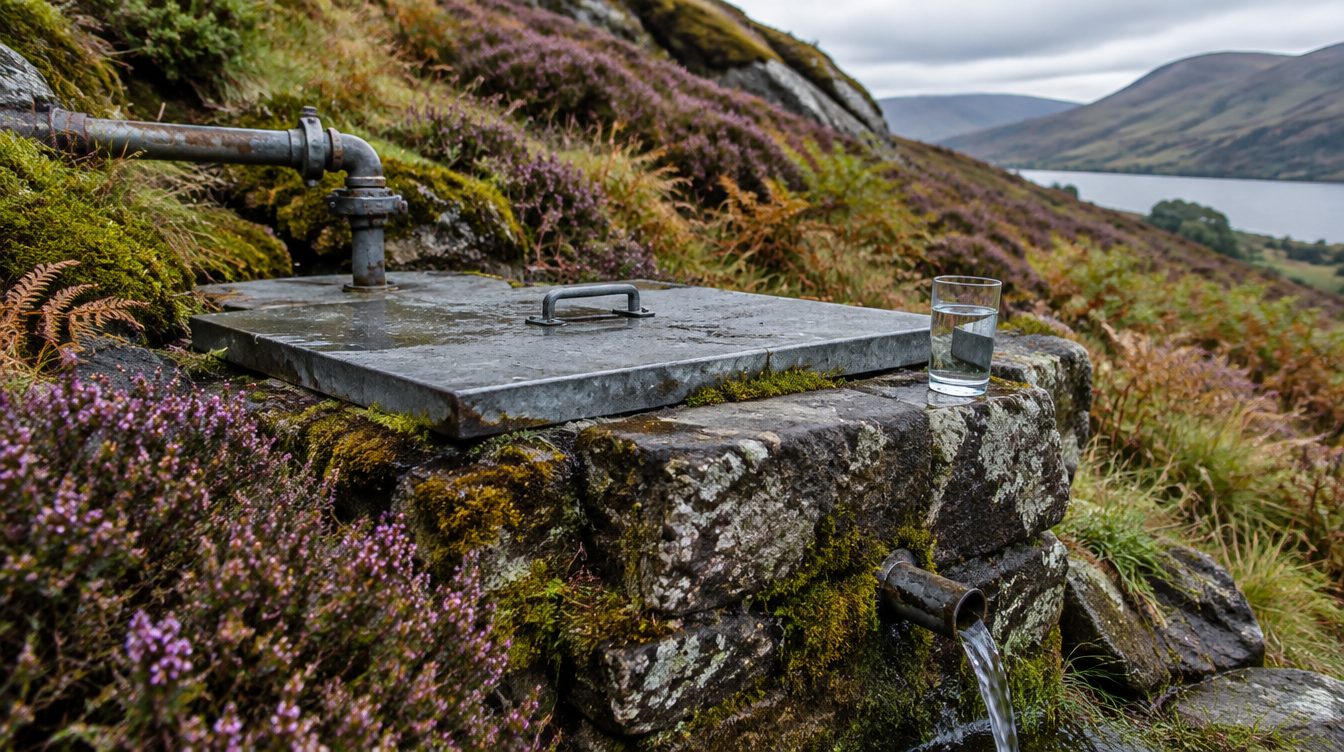
A private water supply is any water supply that is not provided by Scottish Water. The source might be a spring on the hillside, a borehole drilled into rock, a shallow well, a burn, a loch or even rainwater. Water is usually collected in a tank, sometimes treated with filters or an ultraviolet unit, and then piped to the house.
Some supplies serve a single house. Others are shared by a small cluster of cottages, a farm steading or a whole hamlet, with one source and a network of pipes crossing several pieces of land. Private supplies are especially common in the Highlands, Aberdeenshire, the Borders, Dumfries and Galloway, Argyll and the islands. Aberdeenshire alone has more than 8,000 of them, according to the council.
From a buyer’s point of view, the key difference is responsibility. With mains water, Scottish Water looks after quality and supply. With a private supply, the owners and users are responsible for keeping the water safe, maintaining the equipment and dealing with problems such as a source running low in dry weather.
What do the Scottish rules say about private water supplies?
Private supplies are regulated by your local council’s environmental health team, with oversight from the Drinking Water Quality Regulator for Scotland. The main legislation is the Water Intended for Human Consumption (Private Supplies) (Scotland) Regulations 2017, which sorts supplies into two groups. Councils often call these Type A and Type B supplies.
Regulated (Type A) supplies
A supply is regulated if it provides an average of 10 cubic metres of water a day or more, or serves 50 or more people. Any supply, however small, also becomes regulated if any of the water is used as part of a commercial or public activity. Councils treat holiday lets, bed and breakfasts, food businesses, campsites, workplaces and rented homes as commercial use.
For regulated supplies, the council must keep a register, carry out a risk assessment and take samples on a regular basis. The council can charge for this work, and it can serve notices requiring improvements if the water is not safe.
Exempt (Type B) supplies
A supply that provides less than 10 cubic metres a day and serves fewer than 50 people, with no commercial use, is exempt from the 2017 Regulations. Most supplies that serve one or a few owner occupied homes fall into this group. The council does not routinely test them, but it must tell users that the supply is exempt, explain what they can do to protect their health and give prompt advice if it becomes aware of a danger. Owners can still ask the council to sample the water, usually for a fee.
| Regulated (Type A) supply | Exempt (Type B) supply | |
|---|---|---|
| Typical example | Shared estate supply, holiday let, B&B, rented cottage, farm business | A spring or borehole serving your own home or a few neighbouring homes |
| Size threshold | 10 cubic metres a day or more, or 50 or more people | Less than 10 cubic metres a day and fewer than 50 people |
| Commercial use | Yes, any commercial or public use makes it regulated | No commercial or public use |
| Council testing | Regular risk assessment and sampling by the council | On request, usually at the owner’s cost |
| What a buyer will expect | Council register entry, recent risk assessment and sample results | A recent test certificate and details of any treatment |
If you are not sure which category your supply falls into, your council’s environmental health department can tell you whether it is on their register and how it is classified. It is worth asking before you put the house on the market, because it is one of the first questions a buyer’s solicitor will raise.
What will buyers and their solicitors ask about the water?
In a Scottish sale, the buyer’s solicitor will examine your title, the Home Report and the replies to their enquiries before missives are concluded. With a private supply, expect questions in four main areas.
The Home Report
If you are selling on the open market you will need a Home Report. The property questionnaire you fill in asks which services are connected, including whether the water is mains or private, and the surveyor will note the type of supply in the single survey. Be accurate and specific here. Vague or incorrect answers create suspicion later, and our guide to what you must disclose when selling in Scotland explains why honesty at this stage protects you. For more on the report itself, see whether you need a Home Report and have to clear the house before selling.
Water quality and test results
Most buyers, and many lenders, will want to see a recent analysis showing that the water meets drinking water standards for bacteria and chemical parameters such as nitrates, lead, iron and manganese. Solicitors commonly ask for a certificate that is no more than a few months old. If your supply has treatment equipment, have details of what it is, when filters or ultraviolet lamps were last changed and who services it.
Legal rights to the source and the pipes
This is where many rural sales slow down. If the spring, borehole, tank or any length of pipe sits on land you do not own, the buyer needs to know you have a legal right to take water from it, to run the pipes across that land and to go onto it to repair and maintain them. In Scotland these rights are called servitudes.
Scots law recognises a right to lead a pipe over or under a neighbour’s land as a servitude under the Title Conditions (Scotland) Act 2003. Ideally the right will be written into your title deeds and registered against both properties. Where it is not, a servitude can sometimes be established by 20 years of open, peaceable use without challenge under the Prescription and Limitation (Scotland) Act 1973, although proving this usually needs evidence such as statements from people who know the history. The Land Register of Scotland entry for your property is the starting point for checking what is already in place.
Sharing, maintenance and costs
If the supply is shared, the buyer will want to know who owns the source, how costs are split, who arranges repairs and what happens in a dry summer. Informal arrangements between neighbours are common, but they can cause friction when a new owner arrives who was not part of the original handshake. Solicitors who deal with rural property report a growing number of disputes over water rights, so anything you can put in writing helps. Our guide to resolving a shared driveway dispute in Scotland covers how shared rights and neighbour disagreements are handled in a sale, and many of the same principles apply to water.
Good to know: if a servitude for your water supply is missing or unclear, your solicitor may be able to fix it before the sale by asking the neighbouring owner to sign a deed of servitude. This takes time and goodwill, so raise it early rather than waiting for the buyer’s solicitor to find it.
How do mortgage lenders view a private water supply?
Many lenders will happily lend on a home with a private supply, but they want comfort that the property is habitable and that the water is wholesome and reliable. The lender’s valuer will note the supply in the Home Report or their own valuation, and the lender may ask the buyer’s solicitor to confirm that satisfactory test results and legal rights are in place. Requirements differ between lenders, so the buyer’s broker or solicitor will check the specific conditions.
If a lender is not satisfied, the buyer’s mortgage offer may be delayed or come with conditions, such as a retention until treatment is installed. That is one of the main reasons sales on private supplies can stall, and our guide to what happens if your buyer’s mortgage application is declined explains your options if it falls through.
How do you arrange a water test before selling?
Getting a test done before you market the property is one of the simplest ways to avoid delays. A typical process looks like this:
- Contact your council: ask environmental health whether your supply is registered, whether it is regulated or exempt, and how to request a sample. Many councils have an online request form.
- Service your treatment: some councils recommend changing filters and servicing any treatment unit before the sample is taken, so the result reflects the system working properly.
- Pay the fee and book a visit: fees vary by council and by the type of analysis. Some councils require payment before the visit and charge extra if the sampler cannot get access.
- Provide access: the sample is normally taken from the main drinking water tap inside the house, after any treatment.
- Wait for the certificate: results often take around two weeks. Dumfries and Galloway Council, for example, says results are normally available 10 to 12 working days after sampling.
- Share the results: give the certificate to your solicitor or estate agent so it can be provided to buyers with the Home Report.
Some sellers use an accredited private laboratory instead. Check with your solicitor that the buyer’s side will accept the results, as some prefer council sampling.
What happens if the water fails a test?
A failed test is not the end of a sale, but it does need dealing with. The most common problems are bacteria such as E. coli, which usually point to animal or surface water getting into the source or tank, and naturally high levels of iron, manganese or acidity. For a regulated supply, the council can serve a notice requiring improvements. For an exempt supply, the council will give advice, and buyers will expect to see a plan.
Typical fixes include sealing and fencing the source, cleaning or replacing the tank, fitting filtration and an ultraviolet unit, and replacing old lead pipework. Many of these are modest jobs compared with the value of a rural home, and showing that the problem has been fixed and retested is usually enough to reassure a buyer.
The private water supply grant
The Scottish Government funds councils to run a private water supply grant. According to mygov.scot, the key details are:
| Grant detail | What it means |
|---|---|
| How much | Up to £800 per property, with possible extra help from your council if you have a low income |
| What it pays for | Improvements such as installing treatment, replacing lead pipes and new water tanks |
| What it does not cover | Ongoing maintenance or connecting to the mains network |
| Who qualifies | Where the private supply is the main or sole source of drinking water and needs improved to make it safe |
| When you cannot get it | New houses, homes also connected to the mains, work already started or finished, or buildings due for demolition or not fit to live in |
| How to apply | Through your local council’s environmental health department |
Because the grant cannot be paid for work that has already started, apply before you book a contractor. If you are planning to sell soon, check timescales with your council, as you may decide it is better to sell with a quote for the work than to wait.
Could you connect to the mains instead?
If a Scottish Water main runs nearby, a buyer may ask whether the house could be connected. Connections are arranged through Scottish Water, and the cost depends heavily on distance, ground conditions and whether neighbours share the work. The private water supply grant cannot be used for this. You do not need to connect before selling, but if you have ever had a quote, keep it on file, as it helps a buyer weigh up their options.
Are there extra rules for holiday lets and rented homes?
Yes. If any property on the supply is a holiday let, a B&B, a business or a rented home, the supply is regulated, and the council must risk assess and sample it. Private landlords must also meet the Repairing Standard, which includes making sure tenants have an adequate supply of safe drinking water. Buyers will expect to see the council’s risk assessment, recent results and evidence that any notices have been complied with.
If you are a landlord selling with tenants in place, read our guide to selling a house with a sitting tenant in Scotland as well.
What other rural issues often come up at the same time?
Homes on private water rarely have mains drainage either, so a buyer’s solicitor will often ask about the septic tank and its SEPA registration in the same breath. Our guide to selling a house in Scotland with a septic tank covers that side of things. Access is another common question, especially if the house is reached by a private track, so it is worth reading about selling a house on an unadopted road and, for some farm properties, agricultural occupancy conditions.
There is one small upside to mention to buyers. Scottish Water charges on the council tax bill apply to households connected to the public water supply or public waste water network. A home that is not connected to the public water supply should not be billed the water supply charge, although a sewerage charge may still apply if the house drains to a public sewer. If you are clearing up your account before moving, our guide to selling with council tax arrears in Scotland explains how outstanding bills are dealt with.
Does a private water supply affect the value of a house?
A well managed supply with good test results, clear legal rights and a sensible sharing arrangement usually has little effect on value. Many rural buyers expect it, and some actively like not being on the mains. Value is more likely to be affected when the water has failed tests, the supply runs dry in summer, the legal rights are missing or there is an ongoing dispute with a neighbour. These issues narrow the pool of buyers and can lead to lower offers or conditions in the missives. For a wider view, see the factors that can reduce the value of a house in Scotland.
If you receive several offers, a buyer who is relaxed about the supply and has funding in place may be a better choice than the highest bidder whose lender is still asking questions. Our guide on whether you have to accept the highest offer in Scotland explains how to compare them.
Checklist: what to gather before you sell
Pulling these together before you market the property makes the conveyancing far smoother. Add them to the wider list of documents you need to sell a house in Scotland.
- Water test certificate: a recent bacteriological and chemical analysis, ideally from the council.
- Council records: confirmation of whether the supply is registered and regulated or exempt, plus any risk assessment or notices.
- Treatment details: make and model of any filters or ultraviolet unit, service records and receipts.
- A simple plan: a sketch showing the source, tank and pipe route, and whose land they cross.
- Title deeds: any servitude rights, maintenance obligations or water agreements with neighbours.
- Grant paperwork: evidence of any private water supply grant and the work it funded.
- Practical notes: who to call if the supply fails and what has happened in previous dry spells.
Good to know: if you are not sure whether your water is safe to drink, do not guess or reassure a buyer that it is. Get it tested, and speak to your solicitor about how to describe the supply in your replies to enquiries.
Selling quickly without the water questions holding you up
For many sellers, a traditional sale works well once the paperwork is in order. But if the supply has failed a test, the servitudes are unclear or you simply need to move quickly, the back and forth with buyers, solicitors and lenders can add weeks or months.
At Sell My House Fast in Scotland, we help homeowners sell quickly for cash. Because we are not relying on a mortgage lender, a private water supply does not need to satisfy a lender’s conditions before we can proceed. There are no viewings, no chain and you can choose your date of entry. You can read more about the difference between selling to a cash buyer and using an estate agent before you decide.
Frequently asked questions
Do I have to test my private water supply before selling?
There is no general legal requirement for the owner of an exempt supply to test before selling, but most buyers, solicitors and lenders will ask for recent results. Regulated supplies are already risk assessed and sampled by the council. In practice, arranging a test before you market the property is the quickest way to avoid delays.
How much does a council water test cost?
Fees are set by each council and depend on the type of analysis, so check with your local environmental health team. Some councils also charge if an appointment is cancelled late or the sampler cannot get access, so make sure someone is home.
Can a buyer get a mortgage on a house with a private water supply?
Yes, many lenders lend on homes with private supplies. They will usually want to know that the water is wholesome and that the legal rights are in place, and requirements vary between lenders.
What if the spring is on my neighbour’s land?
That is common. Your title should include a servitude right to take water and run pipes across the neighbour’s land, and to access it for repairs. If the right is not written down, your solicitor can check whether it may have been established by long use or whether a deed of servitude should be agreed with the neighbour.
Can I use the £800 grant if I am about to sell?
You can apply if you meet the conditions, including that the supply is your main source of drinking water and needs improved. The grant cannot be paid for work that has already started, so apply before any work begins and check timescales with your council.
Selling a home with a private water supply?
Get a free, no obligation cash offer and skip the lender questions about your water supply. No viewings, no chain and a date of entry that suits you.
