
Finding subsidence is stressful enough. Trying to sell while your insurer is still investigating, monitoring or arguing about the repair can feel like your whole move is on hold. If you are in that position in Scotland, you do have options.
The short answer is yes, you can sell a house in Scotland with subsidence and an unresolved insurance claim. You must disclose the movement and the open claim, and you will need to decide whether to finish the claim first, pass the benefit of it to your buyer, or sell to a buyer who does not need a mortgage. This guide explains how the claims process works, what buyers, surveyors and lenders will ask for, and how to choose the route that suits you.
Key points at a glance
- Selling is possible: subsidence does not stop a sale, but an open claim makes most mortgage lenders cautious until repairs are signed off.
- Disclosure is essential: the Home Report property questionnaire asks about structural damage and any outstanding insurance claim, so be open from the start.
- Claims take time: insurers usually investigate, monitor movement over a period of months and only then repair, so a claim can run for well over a year.
- Paperwork is your best asset: engineer reports, monitoring results and a certificate of structural adequacy all reassure buyers and lenders.
- Claims do not transfer automatically: passing an open claim to a buyer needs your insurer to agree and careful drafting by your solicitor.
- Cash buyers are an option: a buyer who does not need a mortgage can often proceed while the claim is still open, usually at a price that reflects the risk.
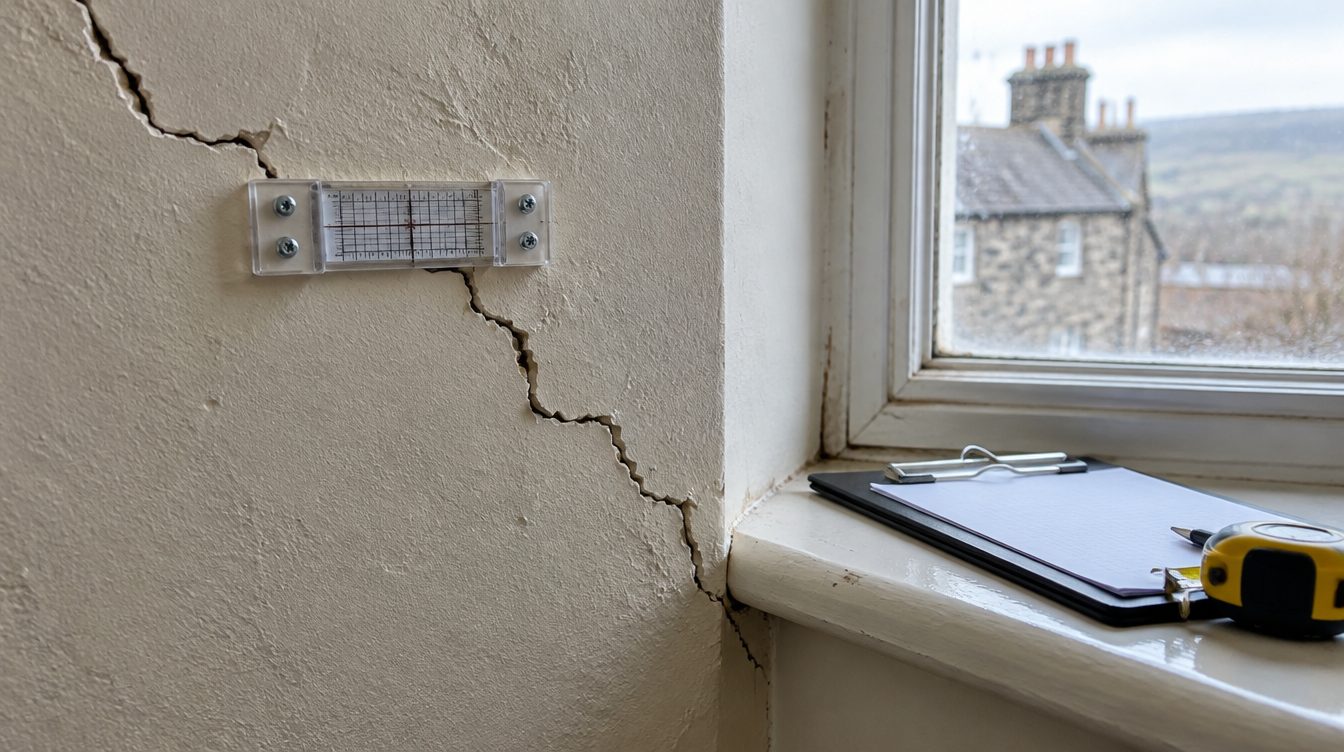
What is subsidence, and why does an open claim make selling harder?
Subsidence is the downward movement of the ground beneath a building, which takes the foundations with it. Common causes include shrinkable clay soils drying out (often made worse by nearby trees), leaking drains washing away fine soil, and, in parts of Scotland, old mine workings. Typical signs are diagonal cracks that are wider at one end, cracks running through to the outside walls, and doors or windows that start to stick.
Not every crack is subsidence, and the label matters because it affects how worried buyers and lenders will be.
- Subsidence: the ground sinks beneath the foundations. Usually covered by buildings insurance, subject to a higher excess.
- Heave: the ground swells and pushes upwards, often after a large tree is removed from clay soil.
- Landslip: ground moving down a slope.
- Settlement: the normal bedding in of a building under its own weight, mostly in the early years. Old settlement is common in older Scottish homes and is usually not a concern on its own.
An unresolved claim matters because it leaves a question mark over three things a buyer cares about: whether the movement has stopped, who will pay for any repair, and whether they will be able to insure the house after they move in. Until those questions have clear answers, many buyers and most lenders will hesitate.
How does a subsidence insurance claim normally work?
Most domestic subsidence claims follow a similar pattern. Knowing where you are in it helps you explain the position to buyers and decide whether to wait for the claim to finish.
- Notify your insurer: report the cracking as soon as you suspect movement. The Association of British Insurers (ABI) says most policies carry an excess of around £1,000 for a subsidence claim.
- Inspection: a loss adjuster or engineer visits to confirm whether the damage is subsidence and whether the claim is valid under your policy.
- Site investigation: this can include trial pits to look at the foundations and soil, root samples, and drain surveys to check for leaks.
- Mitigation: the cause is dealt with first, for example by removing or reducing trees or repairing damaged drains.
- Monitoring: crack gauges or level monitoring are often used over many months, so engineers can see whether the building has stabilised through wetter and drier seasons.
- Repair: once the building is stable, the damage is repaired. Many claims are resolved with crack repairs and redecoration once the cause has been dealt with, while underpinning is usually reserved for more serious damage.
- Sign off: many insurers issue a certificate of structural adequacy (sometimes called a certificate of structural repair) confirming the work has been completed and the building is stable.
| Stage of the claim | What it means for a sale | What a buyer will usually ask for |
|---|---|---|
| Just reported or under investigation | Highest uncertainty: cause, cost and outcome are all unknown | Claim reference, insurer contact details, any initial engineer report |
| Monitoring in progress | Movement is being measured; repairs have not started | Monitoring results to date and the expected end date |
| Repairs agreed or under way | Scope is clearer and the insurer has accepted liability | Schedule of works, engineer report, confirmation the insurer is paying |
| Repairs complete and signed off | The easiest stage at which to sell on the open market | Certificate of structural adequacy, building warrant and completion certificate if structural work needed one |
Good to know: do not cancel or let your buildings insurance lapse while you are selling. Missives in Scotland usually leave the property at the seller’s risk until the date of entry, and an open claim is tied to your policy. Speak to your insurer before you market the house so you understand what happens to the claim when ownership changes.
Do I have to tell buyers about subsidence and an open claim?
Yes. The property questionnaire in the Scottish Home Report asks whether there has been any storm, flood, fire or other structural damage to the property while you have owned it and, if so, whether the damage is the subject of any outstanding insurance claim. It also asks about specialist work and any guarantees. Your answers must be accurate.
Your buyer’s solicitor will then raise further questions, and the missives are likely to include clauses about the condition of the property and any claims. Hiding or playing down subsidence risks a claim for misrepresentation after the sale, which could cost far more than any discount you were trying to avoid. Our guide on what Scottish sellers have to disclose covers the wider rules.
How will the Home Report deal with subsidence?
Most homes marketed for sale in Scotland need a Home Report, which includes a single survey, an energy report and the property questionnaire. The surveyor rates each element of the building from category 1 (no immediate action or repair needed) to category 3 (urgent repairs or replacement are needed now).
Where the surveyor sees evidence of movement, they will usually comment on whether it appears longstanding and inactive or possibly ongoing. Active or unexplained movement often attracts a category 3 rating and a recommendation for a structural engineer’s report. The valuation will reflect the condition of the property, and a buyer’s lender may also hold back part of the loan or decline to lend until the movement has been investigated. If your report has already flagged problems, read what to do when a Home Report highlights major problems.
Can I sell while the subsidence claim is still open?
You can, but how you handle the claim shapes who can buy and at what price. There are four realistic routes.
1. Finish the claim before you sell
Waiting until repairs are complete and signed off gives you the widest pool of buyers and the strongest negotiating position. The downside is time: investigation and monitoring alone can take many months, and you will usually need to stay in the property, or at least keep it insured and maintained, while the claim runs its course.
2. Sell with the claim ongoing and pass on its benefit
Some insurers will agree to the benefit of an open claim being passed to the buyer (in Scotland this is done by an assignation), so the insurer carries on with the repair after the sale. This is not automatic. The ABI’s subsidence agreement deals with changes of insurer, not changes of ownership, so everything depends on your own insurer’s consent and on careful wording in the missives. Your buyer will also need their own buildings insurance from the date of entry, which can be difficult to find while a claim is open.
3. Settle the claim and reflect it in the price
In some cases an insurer may offer a cash settlement instead of carrying out the repairs. If you have a mortgage, check whether your lender needs to consent, and see our guide on when to tell your lender you are selling. A settlement can simplify the sale, but buyers will still want to know the cause has been dealt with and how they will insure the house.
4. Sell to a cash buyer as it is
A buyer who does not need a mortgage is not bound by lender rules about open claims. They will still look carefully at the risk and price it in, but they can often proceed without waiting for monitoring to finish. This suits sellers who need certainty or have already had a sale fall through.
| Route | Advantages | Drawbacks | Often suits |
|---|---|---|---|
| Finish the claim first | Widest pool of buyers; mortgage buyers can proceed; stronger price | Can take a year or more; you stay responsible in the meantime | Sellers with time and no pressing deadline |
| Pass on the benefit of the claim | Repairs continue at the insurer’s cost after the sale | Needs insurer consent and careful missives; buyer insurance can be hard to arrange | Buyers comfortable with risk, often without a mortgage |
| Cash settlement | Removes the insurer from the sale | Buyer still needs confidence the cause is fixed; lender consent may be needed | Smaller claims where the cause has clearly been dealt with |
| Sell to a cash buyer as it is | Speed and certainty; no lender conditions; no viewings | Price reflects the risk and repair cost | Sellers who need to move on or have had a sale fall through |
How do lenders and insurers view a house that has had subsidence?
Mortgage lenders want to know that the building is stable and insurable. Where there is an open claim, many will not lend until repairs are finished and they have seen an engineer’s report or certificate. Even after a claim is closed, some lenders ask for evidence that buildings insurance is available on normal terms. If a buyer’s lender takes a cautious view late in the process, the sale can stall, as explained in our guide to what happens when a buyer’s mortgage is declined.
On the insurance side, a property with a subsidence history is usually seen as a higher risk. Premiums and excesses may be higher and the choice of insurer narrower. Your current insurer, who already knows the property, is often the most realistic option for a buyer, so ask whether they would be willing to quote for a new owner.
What if the subsidence is caused by old mine workings?
Much of central Scotland sits on former coalfields. When a house is in a coal mining area, the buyer’s solicitor will usually obtain a mining report from the Mining Remediation Authority. This is the body formerly known as the Coal Authority: it took its new name on 28 November 2024 and continues to manage the effects of historical coal mining in England, Scotland and Wales.
Damage caused by coal mining subsidence is handled differently from an ordinary insurance claim. You can claim for subsidence damage caused by coal mining from the Mining Remediation Authority, which will send an engineer to inspect and, if the claim is accepted, either repair the damage or pay compensation. GOV.UK says you will usually get a decision within 90 days.
Good to know: if your insurer arranged underpinning or other structural work, ask whether a building warrant was obtained and a completion certificate issued by the council. Buyers’ solicitors check this for structural work, and missing paperwork can delay a sale. Our guide on selling without a building warrant or completion certificate explains how that problem is usually resolved.
What documents should I gather before I sell?
A complete, well organised file is the most useful thing you can give a buyer, so ask your insurer for copies of anything you do not hold.
- Claim correspondence: the claim reference, confirmation that the claim was accepted, and the latest update on its status.
- Engineer and site investigation reports: including the cause identified and what mitigation was carried out, such as tree work or drain repairs.
- Monitoring results: crack or level readings and the engineer’s conclusion on whether the building is stable.
- Schedule of repairs: what has been done or is planned, and who is paying.
- Certificate of structural adequacy: if the claim is complete.
- Building warrant and completion certificate: for underpinning or other structural work that needed them.
- Insurance details: your current policy, the excess paid and whether your insurer would offer cover to a buyer.
How much will subsidence affect the price?
There is no fixed discount. The effect on value depends on the cause and severity of the movement, how far the claim has progressed, the likely cost of any remaining work, and whether the house can be insured on reasonable terms. A house with a completed, certified repair may sell close to normal market value, while one with active, uninvestigated movement will attract far fewer offers.
Our articles on what can reduce the value of a house in Scotland and selling a house with damp or structural issues look at how buyers price in defects. It is also worth reading whether you should fix repairs before selling, because paying for work yourself does not always add as much value as it costs.
Subsidence is not the only insurance event that worries buyers. If your home has also suffered water damage, see our guide on selling a house in Scotland that has been flooded, and for other major damage, our guide to selling a fire damaged house.
Is selling to a cash buyer a sensible option?
For some sellers, yes. Because a cash buyer does not rely on a mortgage, the lender conditions that so often stall subsidence sales simply do not apply. You also avoid repeated viewings and the risk of a buyer withdrawing after their own survey. If you are weighing this up, our comparison of selling to a cash buyer versus an estate agent sets out the pros and cons.
The trade off is price, because a cash buyer takes on the risk and the remaining repair work. Our honest explanation of why cash buyers usually offer less explains how those offers are worked out, and it is sensible to check that any buyer genuinely has the funds available.
At Sell My House Fast in Scotland, we buy houses for cash in their current condition, including homes with subsidence history or an open claim. We will look at your paperwork, explain how we have arrived at our offer, and let you choose a date of entry that suits you. There are no viewings, no chain and no obligation to accept. If you do go ahead, our guide on what happens after a cash offer is accepted walks you through the next steps.
Frequently asked questions
Can I sell my house before my insurer finishes monitoring the subsidence?
Yes. You can market and sell the house at any stage, as long as you disclose the subsidence and the open claim. Mortgage buyers may struggle to proceed until monitoring and repairs are complete, so many sellers in this position either wait or sell to a buyer who does not need a mortgage.
Does an open subsidence claim transfer to the new owner automatically?
No. The claim is part of your insurance contract. Some insurers will agree to the benefit of the claim being passed to the buyer by assignation, but this needs the insurer’s consent and careful drafting in the missives by your solicitor.
What is a certificate of structural adequacy?
It is a document, usually issued by the insurer’s engineer once repairs are complete, confirming that the cause of the movement has been dealt with and the building is structurally sound. Buyers, lenders and future insurers often ask to see it.
Will my Home Report mention the subsidence?
If the surveyor sees signs of movement, the single survey will normally record them and may give a category 3 rating with a recommendation for further investigation. You must also answer the property questionnaire accurately, including the question about outstanding insurance claims.
Who deals with subsidence caused by old coal mines?
Claims for damage caused by coal mining subsidence go to the Mining Remediation Authority, formerly known as the Coal Authority, rather than to your home insurer. A chartered surveyor can help you establish whether mining is the likely cause.
Want a simpler way to sell a house with subsidence?
If an open claim is holding up your move, we can make a no obligation cash offer on your home as it is, with no viewings, no chain and a date of entry that suits you.
