
You are getting ready to sell, and someone has told you that you need an “electrical safety certificate” first. Perhaps your estate agent mentioned it, perhaps a buyer’s solicitor has asked for one, or perhaps you have read about landlords needing EICRs and assumed the same applies to you. With old wiring, an elderly consumer unit or a house that has been let out, it is easy to worry that the sale will stall until you pay an electrician.
This guide explains what the law in Scotland actually requires, how the rules differ for owner occupiers, landlords, HMOs and short-term lets, what the Home Report surveyor looks at, and what to do if your wiring would not pass an inspection.
The short answer is no, not if you live in the property yourself. There is no law in Scotland that requires an owner occupier to provide an Electrical Installation Condition Report (EICR) when selling a house. The position is different if the property is, or has recently been, let to tenants, used as an HMO or run as a licensed short-term let. Even for an owner occupied home, a buyer or their lender can ask for an electrical report, and a cash buyer can usually buy without one.
Key points at a glance
- An EICR is not a legal requirement for an owner occupier selling a house in Scotland.
- Private landlords must have the electrics inspected at least every five years under the Repairing Standard, and must test appliances they provide.
- If you sell with a sitting tenant, the buyer becomes the landlord and will expect up to date electrical paperwork.
- The Home Report surveyor only looks at the electrics visually and does not test them.
- An EICR is rated satisfactory or unsatisfactory. Any C1, C2 or FI code means unsatisfactory.
- Interlinked smoke and heat alarm rules apply to every home in Scotland, but they are separate from electrical certification.
- A cash buyer can buy as seen, without asking you to commission an EICR or carry out electrical work.
What is an EICR?
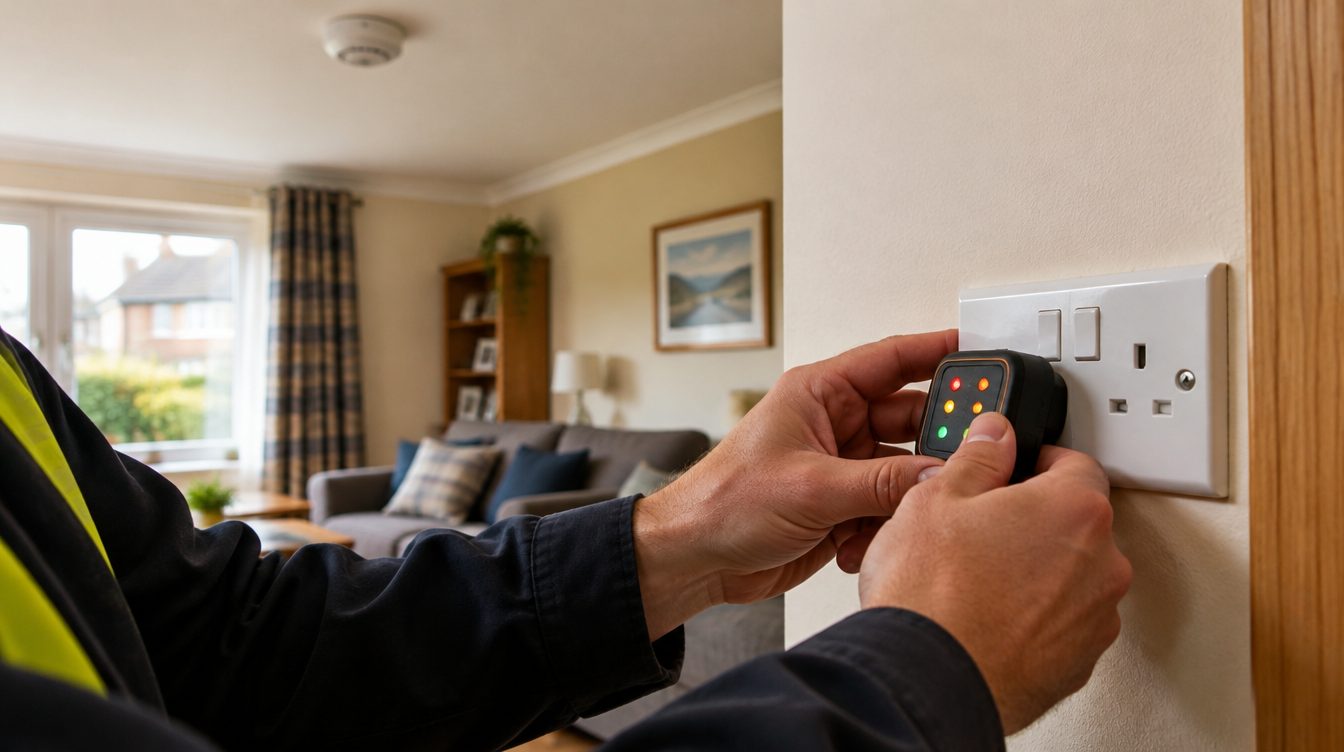
An Electrical Installation Condition Report is a formal inspection and test of the fixed electrical installation in a property. That means the consumer unit (fuse box), wiring, sockets, switches, light fittings and fixed equipment such as electric showers and hard wired heaters. It is carried out to the British Standard for electrical installations, BS 7671.
People often call it an “electrical safety certificate”, but strictly it is a report on condition, not a certificate that the electrics are perfect. It records any defects found, gives each one a code, and gives an overall verdict of satisfactory or unsatisfactory. An EICR is different from an Electrical Installation Certificate (EIC), which is issued when new electrical work, such as a full rewire, is completed.
Is an EICR a legal requirement when selling a house in Scotland?
For an owner occupied home, no. The documents you normally need to market a home in Scotland are the Home Report (made up of the Single Survey, the Energy Report and the property questionnaire) and, as part of the Home Report, an Energy Performance Certificate. Our guide to what documents you need to sell a house in Scotland runs through the full list.
Nothing in Scottish legislation says an owner occupier must commission an EICR before selling. Missives also do not normally require the seller to provide one, unless the buyer’s solicitor asks for it and you agree. Standard missives used across Scotland generally deal with services by asking the seller to confirm they are in working order, rather than requiring a test certificate.
Good to know: Do not confuse an EICR with a gas safety certificate or an EPC. An EPC is legally required to market a home. A gas safety record is a landlord duty, not a requirement for owner occupiers. Our guides to the Energy Performance Certificate when selling and selling without a gas safety certificate explain those separately.
What are a landlord’s electrical safety duties in Scotland?
If you let the property, the position changes completely. Under section 19A of the Housing (Scotland) Act 2006, the Repairing Standard requires landlords to keep the electrical installation, and the fixtures, fittings and appliances they provide, in a reasonable state of repair and proper working order.
The Scottish Government’s Repairing Standard statutory guidance for private landlords, which applies from 1 March 2024, sets out what that means in practice:
- An electrical safety inspection must be carried out before the property is first let and then at intervals of no more than five years.
- The inspection has two parts: an EICR on the fixed installation and portable appliance testing (PAT) on any appliances the landlord provides.
- At least one RCD rated at 30 mA or less must protect the installation at the main consumer unit.
- The landlord must keep the EICR for six years and give a copy of the latest report to a new tenant before the tenancy starts.
- Any item that fails must be repaired or replaced.
Why this matters when you sell a let property
If you sell with a tenant in place, your buyer becomes the landlord and takes on these duties from the date of entry. Their solicitor will normally ask for the current EICR, PAT records, gas safety record and landlord registration details as part of the conveyancing. Missing or out of date paperwork does not stop the sale, but it can delay it or lead to a lower offer. Our guides on selling a house with a sitting tenant and selling a tenanted property in Scotland cover the wider process.
If the tenants have already left, the landlord duties no longer apply to the empty property. However, you remained responsible while it was let, and a buyer may still ask to see the last EICR. If it shows serious faults that were never fixed, expect questions. For more on the options, see our page on selling a rental property in Scotland.
What about HMOs and short-term lets?
Houses in multiple occupation and short-term lets are licensed by the local council, and both licensing regimes include electrical safety.
Houses in multiple occupation
An HMO licence is granted under Part 5 of the Housing (Scotland) Act 2006. Councils expect HMO landlords to meet the Repairing Standard and normally ask for a current EICR and PAT records with a licence application or renewal, along with fire safety and gas safety evidence. The exact conditions vary between councils. If you are selling a property that has been used as an HMO, our guide on selling a former HMO in Scotland explains how the licence, planning and building standards issues fit together.
Short-term lets and Airbnb
Under the Scottish short-term let licensing scheme, hosts must meet mandatory conditions on safety. The Scottish Government guidance for short-term let hosts says hosts must arrange an electrical safety inspection by a competent person, including an EICR for the fixed installation and PAT for appliances guests can use, alongside a gas safety certificate dated within the last 12 months and suitable fire and carbon monoxide detection. If your property is a short-term let, our article on selling a property used as a short-term let or Airbnb covers the licence and planning points a buyer will ask about, which matter most in busy markets such as Edinburgh.
| Type of property | Is an EICR legally required? | What a buyer is likely to ask for |
|---|---|---|
| Owner occupied home | No | Possibly nothing, or an EICR if the Home Report raises concerns |
| Let property with a sitting tenant | Yes, at least every five years under the Repairing Standard | Current EICR, PAT records, gas safety record, landlord registration |
| Former let, now vacant | Not once the tenancy has ended | The last EICR, if available, and evidence that faults were fixed |
| Licensed HMO | Yes, under the Repairing Standard and licence conditions | EICR, PAT, licence details and fire safety evidence |
| Licensed short-term let | Yes, as a mandatory licence condition | EICR, PAT, gas certificate, licence details |
What does the Home Report surveyor check on the electrics?
The Single Survey in the Home Report is a visual inspection. The surveyor does not lift floorboards, move furniture or test services. For the electrics, they will usually look at the consumer unit, the visible wiring and the general age and type of the installation, and record what they see in the services section.
Each part of the property in the Single Survey is given a category rating:
- Category 1: no immediate action or repair is needed.
- Category 2: repairs or replacement requiring future attention, but estimates are still advised.
- Category 3: urgent repairs or replacement are needed now.
Surveyors very often add a comment that the electrical installation should be checked by a registered electrician, particularly where it appears dated, where there is an old style fuse box, or where there are signs of amateur alterations. That comment is a recommendation, not a legal requirement on you. What the Home Report does not do is tell you whether the installation is safe. Only an EICR can do that. Our guides on what a Home Report is and what happens if your Home Report highlights major problems explain the survey in more detail.
When might a buyer or lender ask for an electrical report?
Even though you are not legally required to provide one, an EICR can come up during a sale in several ways:
- The buyer asks. A buyer who reads a Home Report comment about old wiring may make their offer conditional on a satisfactory EICR, or ask for one before missives are concluded.
- The lender asks. A buyer’s lender relies on the Home Report valuation. If the surveyor has flagged the electrics, the lender may want more information or may hold back part of the loan until work is done.
- The property was let. The buyer will want landlord paperwork, as explained above.
- Recent electrical work. If you had a rewire or a new consumer unit fitted, the buyer’s solicitor may ask for the Electrical Installation Certificate or Minor Works Certificate, and the property questionnaire asks about guarantees for electrical work.
If an EICR is requested, you can choose whether to commission one, offer a price reduction instead, or decline. That is a negotiation, and your solicitor can advise you on how to respond.
What do the EICR codes C1, C2, C3 and FI mean?
Each defect found on an EICR is given a classification code. The Scottish Government’s Repairing Standard guidance describes them as follows.
| Code | Meaning | What has to happen |
|---|---|---|
| C1 | Danger present, risk of injury | Must be put right immediately. The electrician should make it safe there and then |
| C2 | Potentially dangerous | Urgent remedial work is required |
| C3 | Improvement recommended | Not dangerous, and not necessarily required under the Repairing Standard |
| FI | Further investigation required without delay | Investigate as soon as possible, as it may reveal a dangerous condition |
An installation with any C1, C2 or FI code is rated unsatisfactory. One with only C3 codes, or no codes at all, can be rated satisfactory. Older installations commonly pick up C3 observations, such as the absence of RCD protection on some circuits, without being unsafe.
Watch out: An unsatisfactory EICR does not stop you selling, but if you commission one you cannot pretend you have not seen it. If you are asked directly about the condition of the electrics, give an honest answer. Our guide on whether you have to disclose every fault explains your position.
How much does an EICR cost?
Prices depend on the size of the property, the number of circuits and how accessible the electrics are. Checkatrade’s cost guide, updated in September 2024, puts a typical EICR at £100 to £250, with around £100 for a flat and £250 or more for a house. An inspection can take at least four hours and sometimes a full day.
Remedial work is charged on top. If the report finds C1 or C2 defects, you may need anything from minor repairs to a new consumer unit or a partial rewire. Get a written quote for any work, and do not feel pressured into using the same electrician who carried out the inspection.
Who can carry out an EICR in Scotland?
The Repairing Standard guidance says the inspection should be done by a “skilled person (electrically)” as defined in BS 7671. In practice, that means an electrician who belongs to a recognised registration scheme run by SELECT (the Electrical Contractors’ Association of Scotland), NICEIC or NAPIT, or someone who can show equivalent competence against the Scottish Government’s checklist.
Using a registered electrician matters for a sale. A buyer’s solicitor, a lender or a council licensing team is more likely to accept a report from a scheme member, and the schemes give you a complaints route if something goes wrong. You can check an electrician’s registration on the relevant scheme’s website.
Do I need a building warrant or completion certificate for electrical work?
Scotland has its own building standards system under the Building (Scotland) Regulations 2004. England’s Part P rules do not apply here, so you will not be asked for a Part P certificate in a Scottish sale.
Where electrical work forms part of a project that needs a building warrant, such as an extension or loft conversion, the council will expect evidence that the electrics comply before it accepts the completion certificate. That evidence is usually either a certificate of construction from an approved certifier, issued through schemes run by bodies such as SELECT and NICEIC, or a BS 7671 certificate signed by a competent, registered installer. Whether a smaller standalone electrical job needs a warrant depends on the work, and your local authority building standards team can confirm. Work that does not need a warrant must still meet the building standards.
If you have an extension or conversion without the right paperwork, our guide to selling a house with an extension and no building warrant explains how buyers’ solicitors usually deal with it.
What about smoke, heat and carbon monoxide alarms?
This is the rule most often confused with electrical certification. Since 1 February 2022, every home in Scotland, whether owned or rented, must have interlinked fire alarms. The mygov.scot guidance on fire alarms sets out the standard:
- One smoke alarm in the room you spend most of the day in, usually the living room.
- One smoke alarm in every hallway and landing.
- One heat alarm in the kitchen.
- All alarms interlinked, so that if one goes off, they all go off.
- A carbon monoxide alarm wherever there is a carbon fuelled appliance, such as a boiler, fire or non electric heater, or a flue.
Alarms can be sealed long life battery units, which you can fit yourself, or mains wired units fitted by an electrician. The law is about the alarms, not about the condition of your wiring, and it does not require any certificate on sale. A buyer’s surveyor or solicitor may still note whether compliant alarms are fitted, so it is usually worth checking before you go on the market.
Should I fix electrical problems before selling?
Not necessarily. If the Home Report flags the electrics, you can choose to commission an EICR and carry out repairs, or leave the issue for the buyer to price in. Repairs can make a home more attractive to mortgage buyers, but you rarely recover every pound spent, and work can uncover more problems once floorboards are lifted. Our guide on whether you need to fix repairs before selling explains how to weigh it up, and our page on selling a house that needs repairs in Scotland sets out the alternatives.
Safety comes first, though. If you know about a dangerous fault, such as scorched sockets, exposed wiring or a fuse box that trips repeatedly, get it made safe whatever you decide about the sale.
How can a cash buyer help if your electrics need work?
A cash buyer does not need a mortgage, so there is no lender asking for an electrical report or holding back funds. You can sell the property as seen, without commissioning an EICR or paying for a rewire first, and choose the date of entry that suits you. That can suit you if:
- The Home Report recommends an electrical check and buyers are backing away.
- You are a landlord with gaps in your safety paperwork, or the tenants have just left.
- The property needs a rewire alongside other work, such as damp or spray foam loft insulation issues.
- You are an executor or are selling after a move into care and cannot manage contractors.
A cash sale is not the right choice for everyone. Cash buyers usually offer less than full open market value in return for speed and certainty. If your home is in good order and you have time, the open market may achieve more. You can read about how our process works and compare it with other routes before you decide. If the property is let, it is also sensible to speak to your solicitor about your landlord obligations up to the date of entry.
Frequently asked questions
Do I need an EICR to sell my house in Scotland if I live in it?
No. There is no legal requirement for an owner occupier to provide an EICR when selling in Scotland. A buyer can ask for one, and you can decide whether to provide it, negotiate on price or decline.
How long is an EICR valid for?
For private landlords in Scotland, the inspection must be repeated at intervals of no more than five years, and the electrician may recommend a shorter interval. For an owner occupied home there is no fixed rule, but a buyer is likely to give more weight to a recent report.
Does the Home Report test the electrics?
No. The Single Survey is a visual inspection only. The surveyor looks at what can be seen and may recommend that a registered electrician checks the installation, but does not carry out any electrical testing.
Can I sell a house that failed its EICR?
Yes. An unsatisfactory EICR does not prevent a sale. You can carry out the repairs, reduce the price to reflect them, or sell to a buyer who is willing to take the property as it is, such as a cash buyer.
Do the fire alarm rules affect my sale?
There is no certificate to provide, but every Scottish home must have interlinked smoke and heat alarms and, where needed, a carbon monoxide alarm. A buyer may note whether they are fitted, so check before you market the property.
Is Part P relevant when selling a house in Scotland?
No. Part P is part of the building regulations in England and Wales. In Scotland, electrical work is covered by the Scottish building standards system, so the relevant paperwork is a building warrant, completion certificate or electrical installation certificate where applicable.
Worried about old wiring holding up your sale?
Get a free, no obligation cash offer for your home as it is, with no EICR to arrange and no electrical work to pay for first.
