
You have spotted tall, bamboo like canes at the bottom of the garden, or a surveyor has just written the words “Japanese knotweed” into your Home Report. Either way, it is natural to worry that your house has suddenly become unsellable, or that a neighbour or buyer will take you to court.
The reality in Scotland is far less dramatic than the headlines suggest, but it does need handling properly. This guide explains how knotweed is identified, what the Home Report and missives say about it, how lenders treat it today, what the law in Scotland actually requires of you, and the realistic ways to sell.
The short answer is yes, you can sell a house in Scotland with Japanese knotweed. There is no law that stops the sale. What matters is that you are honest about it, that the infestation is assessed under the current RICS framework, and that a professional treatment plan is in place if a buyer’s lender asks for one. If you cannot wait for a treatment programme to run its course, or buyers keep walking away, selling to a cash buyer who does not need a mortgage is another option.
Key points at a glance
- Knotweed does not make a Scottish property unsellable, but it can affect value, mortgage approval and the time a sale takes.
- The Scottish property questionnaire does not name knotweed, but the Scottish Standard Clauses used in most offers now ask the seller about it directly.
- Since 2022, surveyors use the RICS management categories A to D, and the old “7 metre rule” has been replaced by a 3 metre test for knotweed next door.
- Many lenders will now lend where a specialist management plan, often with an insurance backed guarantee, is in place.
- Having knotweed in your garden is not a crime in Scotland, but letting it spread into the wild, or disposing of it carelessly, can be.
- A cash buyer does not need lender approval, so a sale can go ahead before treatment is finished.
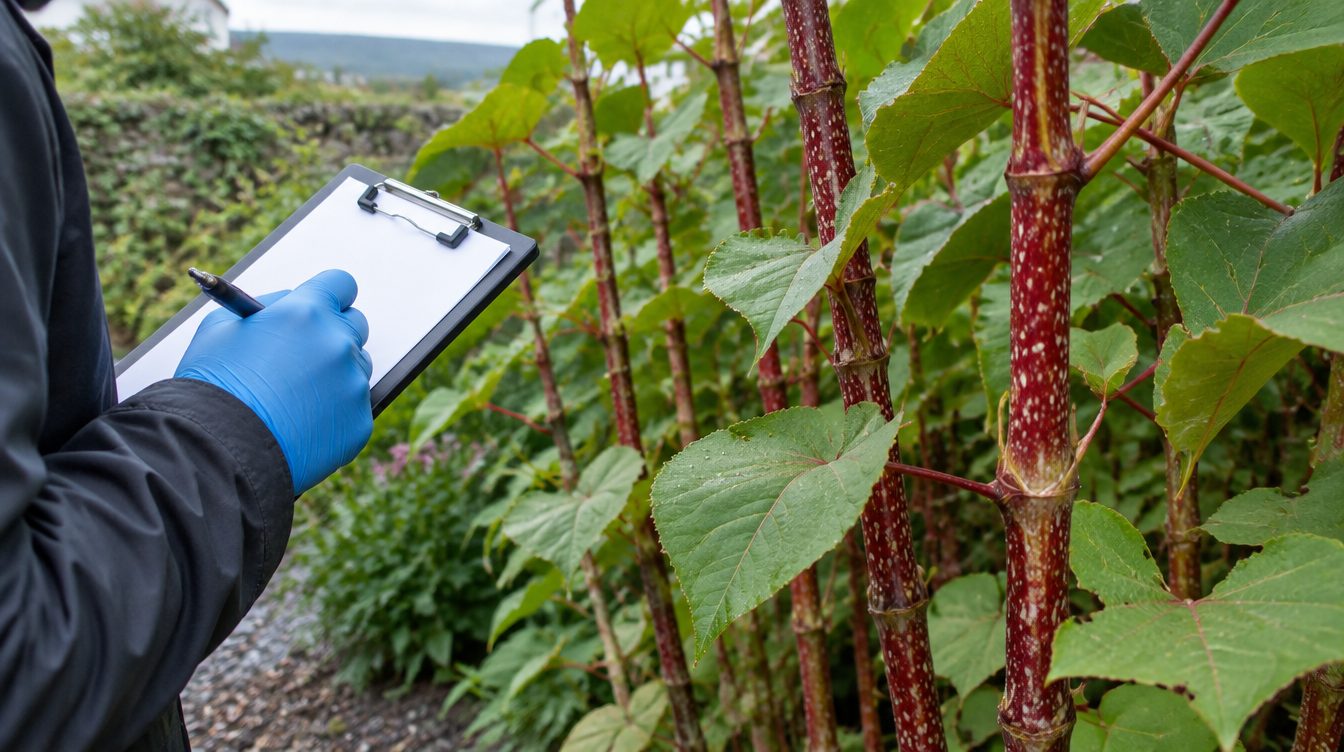
What is Japanese knotweed and how do you identify it?
Japanese knotweed (Reynoutria japonica, also known as Fallopia japonica) is an invasive plant that was introduced to Britain as an ornamental in the nineteenth century. It spreads through underground stems called rhizomes, and even a small fragment of rhizome or stem can grow into a new plant. That is why it is taken so seriously by surveyors and lenders.
It looks different depending on the time of year, which is one reason people miss it when they buy a house in winter.
- Spring: red or purple shoots appear, a little like asparagus spears, and grow very quickly.
- Summer: dense stands of hollow, bamboo like stems with purple speckles, often two to three metres tall, with flat based, shield or heart shaped leaves arranged in a zigzag along the stem.
- Late summer and autumn: clusters of small creamy white flowers.
- Winter: the plant dies back to brittle brown canes, while the rhizomes stay alive underground.
Several harmless plants are often mistaken for it, including bindweed, Russian vine, Himalayan honeysuckle and some bamboos. If you are not sure, a specialist survey is the only reliable way to confirm it and to map how far the rhizomes extend. Do not dig or strim it to “check”, because that can spread it.
Does the Home Report have to mention Japanese knotweed?
A Scottish Home Report has three parts: the single survey and valuation, the energy report and the property questionnaire. If you want a refresher on how these fit together, our guide to what a Home Report is and why you need one explains each section.
The single survey
The surveyor carries out a visual inspection. If knotweed is clearly visible on the day, they should note it and assess it under the RICS framework described below. If it is winter and the canes have been cleared, or the plant is hidden behind a shed, it may not be picked up at all. That does not change what you know as the seller, which matters for the questions you answer later.
The property questionnaire
The property questionnaire prescribed under the Home Report regulations has 16 sections, covering things such as alterations, central heating, structural damage, specialist works, guarantees and notices. None of the questions mentions Japanese knotweed by name. However, if you have had specialist treatment carried out, it may fall within the question about “any other specialist work”, and any guarantee for that treatment belongs under the guarantees section.
You sign a declaration that the information is “true and correct to the best of my/our knowledge and belief”, so you should never give an answer you know to be misleading.
Do I have to tell a buyer about knotweed under Scots law?
Scots law does not impose a general duty on sellers to volunteer every defect. However, you must not misrepresent the property, and in practice you will almost certainly be asked about knotweed directly in the missives.
Most residential offers in Scotland incorporate the Scottish Standard Clauses, produced by solicitors across the country and published by the Law Society of Scotland. The fifth edition, recommended for use from August 2022, added a question about Japanese knotweed and other invasive plants. The current sixth edition, recommended from the start of 2025, has the seller confirm that, so far as they are aware, the property is not affected by “Japanese knotweed”. If you know it is there and stay silent, you are likely to be in breach of that clause.
This is not a theoretical risk. In Busby and Donnelly v Blair [2024] SC EDIN 24, buyers of a property near Penicuik discovered knotweed after moving in. The sellers had known about it and had tried to treat it. The missives used an older clause about “other infestation”, and the sheriff held that this wording was wide enough to cover knotweed, so the buyers’ claim was allowed to proceed. The newer wording now names knotweed expressly, which makes the position even clearer.
Watch out: cutting the knotweed down before photographs or viewings does not remove the problem, and it can create a misrepresentation claim later. Telling your solicitor at the outset, and having a survey and plan ready, protects you far more than hoping nobody notices.
Our guide on whether you have to disclose every fault when selling in Scotland covers the wider rules, and your own solicitor can advise on how to word the missives for your circumstances.
What do the RICS management categories mean?
In 2022, RICS replaced its 2012 information paper with new guidance, Japanese knotweed and residential property, which took effect on 23 March 2022 and was reissued as a professional standard in October 2022. It moved the focus from automatic alarm to a proportionate, risk based assessment. Two changes matter most to sellers.
- The old rule that treated any knotweed within seven metres of a building as a serious risk was dropped. For knotweed on neighbouring land, the trigger is now three metres from your boundary, which reflects research showing that rhizomes rarely spread as far as once feared.
- Surveyors now place an infestation into one of four management categories, which tell a lender how serious it is.
| Category | What the surveyor has found | Likely lender response |
|---|---|---|
| A (Action) | Knotweed on the property causing visible damage to a significant structure, such as the house, a garage or a boundary wall | Usually a retention or delay until a specialist report and remediation plan are provided |
| B (Action) | Knotweed on the property, not damaging structures, but restricting use of the garden or access | Usually a specialist report and treatment plan before funds are released |
| C (Manage) | Knotweed on the property, not causing damage or restricting amenity | Retention not normally expected; treatment is at the owner’s discretion |
| D (Report) | Knotweed on neighbouring land within 3 metres of the boundary | Retention not normally expected, as the owner has no control over the adjoining land |
Knotweed further than three metres from your boundary on someone else’s land is not normally reported to lenders, unless it is particularly widespread, mature and clearly not being managed. If your Home Report flags knotweed, check which category the surveyor has used, because the difference between Category A and Category C is enormous for your sale. Our article on what happens if your Home Report highlights major problems explains how to respond to a difficult survey.
Will a buyer get a mortgage on a house with knotweed?
Often, yes. There is no single industry wide rule, and each lender sets its own policy, but the general picture has improved since the RICS changes. Many lenders will now lend where the knotweed is covered by a professional management plan from a specialist firm, typically one that belongs to a recognised trade body such as the Property Care Association, backed by an insurance backed guarantee that can transfer to the buyer.
Where lenders still differ is on Category A and B cases and on how far into a treatment programme the property needs to be. Some lenders are comfortable once a plan is signed and paid for; others want to see that treatment has started or that a full cycle is complete. A buyer can have an offer withdrawn late in the process if their lender’s valuer takes a stricter view, which is exactly the situation covered in our guide to what happens if your buyer’s mortgage application is declined.
Is it illegal to have Japanese knotweed in Scotland?
No. It is not an offence simply to have knotweed growing in your garden, and you are not legally required to report it. The law in Scotland focuses on spreading it.
The Wildlife and Natural Environment (Scotland) Act 2011 amended section 14 of the Wildlife and Countryside Act 1981 for Scotland. It is now an offence to plant, or otherwise cause to grow, any plant in the wild at a place outwith its native range. The Scottish Government’s non-native species code of practice explains that private gardens are not “the wild”, but that it can be an offence to let a non-native plant spread from a garden into the wild. It gives strimming Japanese knotweed and fly tipping garden waste as examples of actions that could cause a plant to grow in the wild.
The same legislation gives NatureScot, SEPA and the Scottish Ministers powers to agree species control agreements with owners, and to make species control orders where an agreement is refused or broken. In practice these powers are aimed at wider environmental problems rather than ordinary gardens, but they show that the duty is about control, not concealment.
How do you dispose of knotweed legally in Scotland?
NatureScot advises that invasive plant material and contaminated soil are controlled waste and must go to an appropriately licensed landfill. That means you should not put it in your household brown bin, take it to a council recycling centre or add it to the compost heap.
- Material leaving the site should be taken by a registered waste carrier to a site authorised to accept it, with a waste transfer note that records the invasive plant material.
- Loads must be covered so fragments cannot blow away during transport.
- Burying or burning material on site has its own rules, and using herbicide in or near a watercourse may need authorisation from SEPA, so check before any treatment near water.
- Herbicide should be applied by someone holding the appropriate certificate of competence, using a product approved for that use.
This is one of the main reasons to use a specialist firm rather than tackling it yourself. A reputable contractor handles the waste chain correctly and gives you paperwork that a buyer’s solicitor and lender will want to see.
What if the knotweed is on my neighbour’s land, or spreads to theirs?
Disputes between neighbours over knotweed are dealt with under the Scots law of nuisance. The question is whether the interference goes beyond what a neighbour can reasonably be expected to tolerate. A court can grant interdict to stop a continuing nuisance, but a claim for damages in Scotland generally requires the other party to show fault, for example that the owner knew or should have known about the knotweed and failed to take reasonable steps to control it.
You may read about Williams v Network Rail, where the Court of Appeal in England awarded damages to homeowners whose gardens were affected by knotweed from railway land. That case is English and is not binding in Scotland, although a Scottish court could treat its reasoning as persuasive. If knotweed is coming from next door, keep a record, write to the owner politely, and take advice from a solicitor before any dispute escalates. Our guide to neighbour disputes over shared driveways covers how ongoing disputes can affect a sale more generally.
How much does knotweed treatment cost and how long does it take?
Costs depend on the size of the stand, how far the rhizomes extend, access and the method used. A specialist survey comes first, and the quote follows from it.
| Method | How it works | Typical timescale | Relative cost |
|---|---|---|---|
| Herbicide treatment programme | Repeated applications to weaken and control the plant, with monitoring visits | Around two to three years to achieve effective control, with programmes often running longer and guarantees of 5 to 10 years | Usually the lower cost option for a small domestic stand |
| Excavation and removal | Digging out the plant and rhizomes and taking contaminated soil to licensed landfill | Days to weeks on site, plus follow up monitoring | Usually much higher, because of digging, transport and landfill charges |
Prices vary widely, so get written quotes from more than one specialist. Larger stands, difficult access and hard landscaping all push prices higher. Herbicide does not usually kill every rhizome, so lenders and buyers are reassured by a written plan and a guarantee rather than by the plant simply disappearing for a season.
How much does Japanese knotweed reduce a property’s value?
There is no fixed percentage, and you should be wary of anyone who quotes one. Under the RICS framework, the effect on value in Category A and B cases mainly reflects the cost of remediation and repairs, plus the extra hassle and uncertainty for a buyer. In Category C cases the effect is described as much lower, and Category D knotweed next door often has little effect at all once a buyer understands it.
What tends to cost sellers most is not the plant itself but delay: a sale that falls through, a property that sits on the market, or a reduced offer agreed under pressure. Our guide to what can reduce the value of a house in Scotland puts knotweed alongside other issues buyers price in.
What are my options for selling a house with knotweed?
Treat first, then sell on the open market
Commission a specialist survey, agree a management plan with an insurance backed guarantee, and give the paperwork to your solicitor before you market the property. This gives mortgage buyers the best chance of approval and usually protects your price, but it costs money up front and can take time. Our guide on whether you need to fix repairs before selling helps you weigh that up.
Sell on the open market with a plan in place but treatment ongoing
Many sellers market the property once the plan is signed, with the guarantee transferring to the buyer. This works well for Category C and D cases. It is less predictable for Category A or B, where some lenders will still hesitate.
Sell to a cash buyer as seen
A cash buyer does not need a mortgage, so the lender’s view of the knotweed does not apply. This can suit you if the house already has other issues, such as damp or structural problems, or if you are dealing with a sale that has already fallen through. If your property has more than one lender red flag, our related guides on selling with spray foam loft insulation and selling a home built with RAAC cover the other issues lenders most often query.
Good to know: executors often discover knotweed only when they come to market a late relative’s house. If you are in that position, our page on selling an inherited house in Scotland explains how the sale fits around confirmation and the executry.
How can a cash sale help if my house has knotweed?
Selling to a cash buyer is not the right answer for everyone, so it is worth being clear about when it helps and when it may not.
When it can suit you: a cash buyer can often move faster than a chain, does not need lender approval, can buy the house as seen without you arranging treatment first, and lets you choose a date of entry that works for you. That is useful if a buyer’s lender has refused, if the knotweed sits in Category A or B, or if you simply do not want to manage a multi year treatment programme for a house you are leaving. It is also an option for properties that are hard to sell for several reasons at once.
When it may not: a cash offer will normally be below full open market value, because the buyer takes on the cost and risk of treatment. If your knotweed is Category C or D, you have time on your side and a plan is already in place, the open market may give you a better net result. Our guide on why cash buyers pay less explains the trade off honestly.
We buy homes across Scotland, including in Glasgow and throughout Lanarkshire, where knotweed is common along river corridors, railway lines and former industrial land. You can read how our process works before deciding whether to ask for an offer, and nothing obliges you to accept it.
Frequently asked questions
Does the Scottish property questionnaire ask about Japanese knotweed?
Not by name. The 16 section questionnaire covers specialist works and guarantees, which can include knotweed treatment. The direct question usually comes in the missives, where the Scottish Standard Clauses ask the seller to confirm, so far as they are aware, that the property is not affected by Japanese knotweed.
Can I just dig it out myself before I sell?
It is not recommended. Fragments regrow easily, disturbed rhizomes can spread further, and the waste must go to licensed landfill through a registered carrier. Lenders also want a specialist’s report and guarantee, which you will not have if you do it yourself.
Is the 7 metre rule still used?
No. RICS replaced it in 2022. Surveyors now assess knotweed on the property using management categories A to C, and normally only report knotweed on neighbouring land if it is within three metres of your boundary (Category D).
What if knotweed is found after the sale has settled?
If you knew about it and confirmed in the missives that you were not aware of any, the buyer may have a claim against you for breach of contract or misrepresentation, as in the Busby case. If you genuinely did not know, the standard clause is limited to your awareness. Speak to a solicitor if a claim is made.
Will my home insurance pay for knotweed treatment?
Many standard home insurance policies exclude knotweed treatment and related damage, but policies vary. Check your wording and ask your insurer before assuming either way.
Do you buy houses with Japanese knotweed?
We are happy to look at houses affected by knotweed, with or without a treatment plan in place. Because we do not need a mortgage to buy, a lender’s view of the knotweed does not hold the sale up.
Selling a house with knotweed?
Tell us about your property and we will give you a free, no obligation cash offer that does not depend on a lender’s view of the knotweed.
