
Perhaps a letter has arrived from the council saying your block has a RAAC roof. Perhaps a buyer’s surveyor has flagged “suspected RAAC” in the loft, or you have watched the news from Torry and Tillicoultry and wondered whether your own former council home is affected. Whichever it is, the worry is the same: can you still sell, and what is your home now worth?
This guide explains what reinforced autoclaved aerated concrete is, where it has been found in Scottish homes, what councils are doing about it as of November 2026, and the realistic routes open to you as an owner.
The short answer is yes, you can legally sell a house or flat in Scotland that contains RAAC. Nothing in Scots law stops the sale. The difficulty is practical: many mortgage lenders are cautious about RAAC, some insurers are wary, and your buyer will want to know the condition of the panels and who is paying for any repairs. That narrows your pool of buyers, which is why owners often weigh up waiting for council works, carrying out remediation, accepting a council buyback where one is offered, or selling as seen to a cash buyer.
Key points at a glance
- RAAC is a lightweight precast concrete used mainly in flat roof panels between the mid 1950s and mid 1990s.
- The Scottish Housing Regulator reported 2,205 social rented homes with RAAC across 17 landlords in July 2025, with Dundee and Aberdeen the most affected councils.
- Many affected private homes are former council properties bought under the Right to Buy, often in mixed tenure blocks.
- You can sell a RAAC property, but mortgage lenders, insurers and buyers will want clear information and a structural engineer’s report.
- In a tenement, the roof is usually shared “scheme property”, so repair costs are normally split between owners under the Tenements (Scotland) Act 2004.
- The Scottish Government’s position is that RAAC is a matter for building owners, and there is no national compensation fund for private owners.
What is RAAC and why is it a problem?
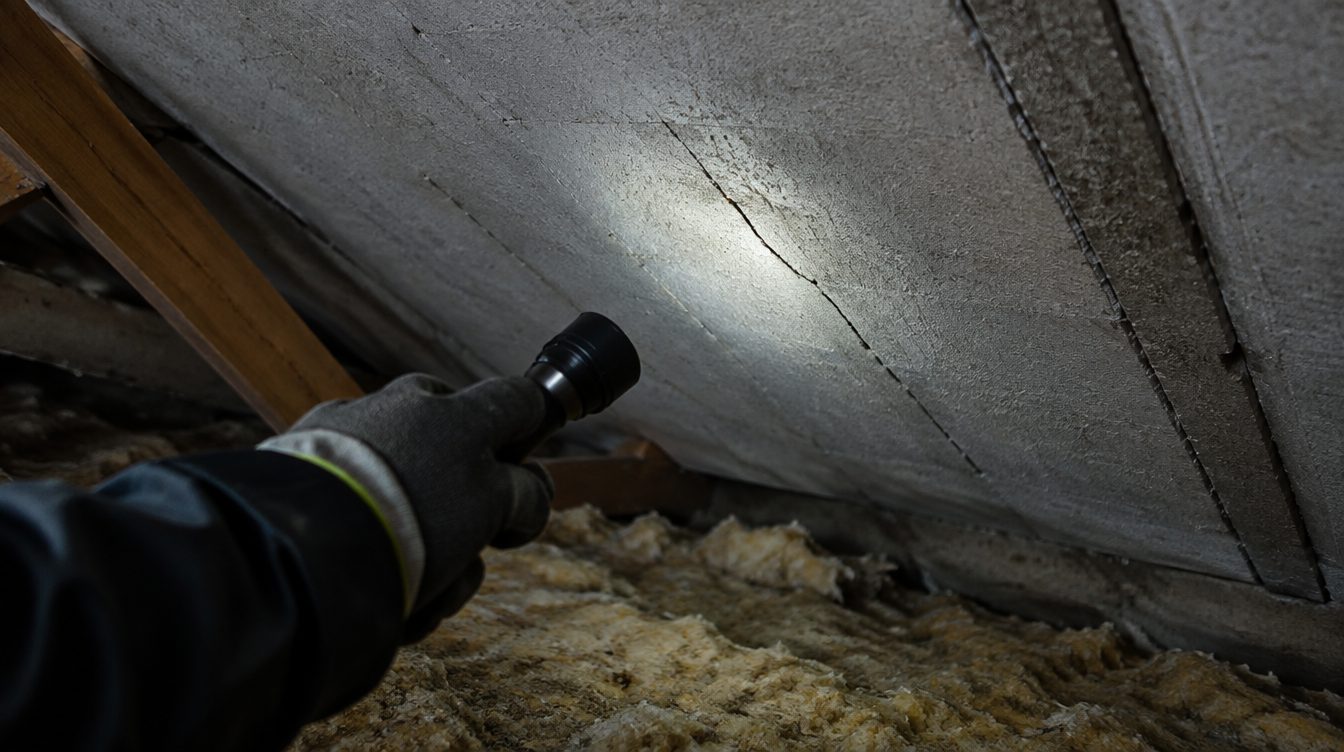
Reinforced autoclaved aerated concrete (RAAC) is a lightweight form of concrete made with tiny air bubbles and strengthened with steel bars. It was cheap, quick to install and a good insulator, so it was popular for flat roof planks, and occasionally for wall panels and floors.
The Institution of Structural Engineers says RAAC was used in UK buildings between the mid 1950s and mid 1990s. The problem is durability. RAAC is much weaker than ordinary concrete, and if water gets in through a failing roof covering, or if the panels were made or installed poorly, they can deflect, crack and in the worst cases fail with little warning.
RICS, the surveyors’ professional body, stresses that finding RAAC is a reason to act, not to panic. Many panels are in fair condition and can be monitored, supported or replaced. Each building has to be assessed individually.
Which Scottish homes were built with RAAC?
In Scotland, RAAC turns up mostly in homes built by councils in the post war decades. Typical examples include low rise flats and cottage style terraces with flat or shallow pitched roofs, and some blocks where only the roof over the stair or a bin store uses RAAC planks.
Because so many council homes were sold to tenants under the Right to Buy, a large share of affected private homes are former council properties. That is why blocks often have a mix of council tenants, owner occupiers and private landlords under one roof. If your home is an ex local authority property, our guide on selling an ex council house in Scotland covers the wider issues buyers and lenders look at.
RICS notes that Victorian villas and 1930s semis are unlikely to contain RAAC unless they have been extended. RAAC is a separate issue from the prefabricated concrete house types designated as defective in the 1980s, although lenders often treat both with caution. Our post on selling a house classed as non-standard construction explains how lenders handle those homes.
Where has RAAC been found in Scottish homes?
After RAAC hit the headlines in 2023, the Scottish Housing Regulator asked every social landlord to check its stock. Its update of July 2025 confirmed that all 17 landlords that found RAAC had concluded their investigations, with 2,205 social rented homes affected, about 0.4% of social homes in Scotland. The council figures were as follows.
| Council | Social rented homes with RAAC (July 2025) |
|---|---|
| Dundee City Council | 516 |
| Aberdeen City Council | 366 |
| South Lanarkshire Council | 157 |
| North Lanarkshire Council | 103 |
| West Lothian Council | 81 |
| Clackmannanshire Council | 69 |
| City of Edinburgh Council | 44 |
| Stirling Council | 26 |
| Angus Council | 25 |
Eight housing associations and other social landlords also reported RAAC, including Almond Housing Association (328 homes), Bridgewater Housing Association (142) and Viewpoint Housing Association (130). You can read the full list on the Scottish Housing Regulator’s RAAC update.
These figures only count homes still owned by social landlords. There is no national figure for privately owned homes. A Scottish Parliament committee paper from March 2025 quoted around 140 private homes in Balnagask, an estimated 337 in West Lothian and 218 in Dundee, and RICS has warned that RAAC may exist in private homes in areas the regulator does not name.
Aberdeen: Balnagask in Torry
Balnagask is the largest single RAAC case in Scotland. RAAC was identified there in 2022, and in August 2024 Aberdeen City Council decided that demolishing and rebuilding was the best option for more than 500 homes: 366 council homes and 138 privately owned homes, according to a council report of February 2025.
Owners were offered a voluntary purchase based on current market value, a home loss payment of 10% of that value, disturbance costs such as removals, and reasonable legal and surveying fees. Many owners rejected the early terms in 2024 because valuations reflected the RAAC problem. In October 2025 the Scottish Government agreed a £10 million funding deal with the council, and the council then agreed in principle to additional payments reported as £20,000 for a one bedroom home, £37,000 for three bedrooms and £44,000 for four bedrooms.
The deadline to accept, originally December 2025, was pushed back, and in August 2026 councillors voted against a further extension, keeping a final deadline of 30 August 2026. STV reported on 19 August 2026 that 128 of the 138 eligible owners had accepted, demolition had started in parts of the estate, and a masterplan for the area is due in summer 2027. If you own in the city, our Aberdeen cash house buyer page explains how we work locally.
Dundee
Dundee has the most social homes with RAAC of any Scottish council, and in October 2026 STV reported nearly 1,000 properties in the city had been found to contain it. The council’s approach is repair rather than demolition. On 26 October 2026 councillors approved a £21 million programme to install new supports beneath RAAC roofs, with a first phase of 48 properties, four of them privately owned, expected to start in January 2027.
Council officers said a buyback scheme would not be viable, and private owners in affected blocks could be asked to pay their share. Councillors also agreed to ask both governments for owner support and to seek assurances that mortgage lenders and insurers will accept the repairs. Owners in the city can see how we help on our Dundee page.
Clackmannanshire
In Tillicoultry, three blocks at Park Street, High Street and Chapelle Crescent were evacuated after RAAC was found in late 2023. STV reported 27 properties affected, 10 of them privately owned, with residents out of their homes for well over a year. In June 2025 the council agreed roof repairs could go ahead, and said it would negotiate individually with owners who wanted to sell, taking account of the expected post repair value, the repair cost and its own spending to date. Our Alloa page covers Clackmannanshire.
West Lothian, Edinburgh, Fife and elsewhere
West Lothian Council surveyed over 14,000 homes and found RAAC in 69 council houses and 19 common blocks. It is replacing affected roofs with new insulated timber flat roofs, starting in Bathgate, Broxburn and Linlithgow Bridge, and says no demolition is planned. Owners remain responsible for their own homes, and shared costs in common blocks are recovered from owners. See our West Lothian area page for local information.
The City of Edinburgh Council reported 44 homes. Fife Council and East Lothian Council both checked their housing and found RAAC in some schools or other public buildings, but neither appears on the regulator’s July 2025 list of landlords with RAAC in homes. If you live in Glasgow, Edinburgh or anywhere not named, do not assume you are clear: a block sold off decades ago may never have been checked.
How do I find out if my home has RAAC?
Start with what you already have, then bring in a professional. These steps are a sensible order.
- Check your post. Councils including Dundee and West Lothian have written to owners in blocks or streets where RAAC was found or suspected.
- Ask your council or housing association. If they own homes in your block, they will usually know what their surveys found.
- Check your factor’s records and any recent owners’ meeting minutes for roof inspections or proposed works.
- Instruct a chartered structural engineer or chartered building surveyor to inspect the roof space. Do not try to break into ceilings yourself, as older textured finishes can contain asbestos.
- Keep every report, letter and invoice. Buyers, valuers and solicitors will ask for them.
In January 2026 the Institution of Structural Engineers published free guidance written specifically for RAAC roof panels in Scottish residential property: Part 1 for initial identification and appraisal by engineers and chartered surveyors, and Part 2 for detailed assessment by structural engineers. The IStructE RAAC resources page lists both. Ask any engineer you instruct whether they will follow it.
Watch out: Dundee City Council has warned that Trading Standards received reports of unqualified traders cold calling owners to offer RAAC surveys. Only use a chartered professional you have checked yourself, ideally a member of IStructE or RICS.
Can I sell a house or flat with RAAC?
Yes. There is no law in Scotland that prevents you selling a home with RAAC, and no licence or certificate is needed. What matters is honesty. If you know about RAAC, or have had a council letter about it, you should tell your solicitor and answer the property questionnaire accurately. Hiding a known defect risks a claim against you after the sale. Our guide on whether you have to disclose every fault when selling in Scotland explains your position.
The real question is who will buy, and at what price. A buyer relying on a mortgage needs their lender to accept the property, and that is where most RAAC sales struggle. A purchaser will also price in any repair bill, much like the issues covered in our guide on selling a flat with cladding issues and an EWS1 valuation, where a single building wide defect affects every flat.
Will a buyer get a mortgage on a RAAC property?
Possibly, but it is far from certain. RICS advises that a valuer who suspects or finds RAAC may ask for an independent specialist report before giving a figure, and that lender policies vary. A RAAC property is not automatically unmortgageable, but many lenders are cautious and some will decline, particularly where panels are rated high risk, works are undecided, or the cost has not been settled.
Your buyer’s chances improve when you can show an engineer’s report, a clear remediation plan, evidence of who is paying, and ideally completed works signed off by an engineer. Even then, a sale can fall over late if the lender’s valuer takes a cautious line. Our post on what happens if your buyer’s mortgage is declined explains your options if that happens.
How does RAAC affect the Home Report and property questionnaire?
The Home Report surveyor carries out a visual inspection. They do not open up the structure, but if they see or suspect RAAC in the roof space they will normally record it, may give the roof an urgent category rating, and may recommend further investigation by a structural engineer. RICS issued a practice alert in February 2026 telling surveyors who inspect Scottish homes to be aware of, and follow where appropriate, the new IStructE guidance.
The valuation may be reduced, or the surveyor may decline to value until a specialist report is available. The property questionnaire also asks about notices affecting the property, shared repairs and charges, so a council letter about roof works or a proposed common repair should be mentioned. If your survey has come back with a serious finding, read our guide on what happens if your Home Report highlights major problems.
What about buildings insurance?
Standard home insurance covers insured events such as storm, fire or escape of water. It does not normally pay to replace a material simply because it is known to be defective. RICS notes that a RAAC roof that is still performing is unlikely to be claimable for replacement, and that if a collapse happens, a policy may cover the resulting damage but not necessarily removal of undamaged panels.
Some owners in affected estates have reported difficulty getting or renewing cover. Tell your insurer once you know about RAAC, because failing to disclose a material fact can affect a claim. A buyer will also need cover from the date of entry, and their lender will insist on it.
Who pays to fix a RAAC roof in a shared block?
For flats, the answer usually starts with your title deeds and, where they are silent, the Tenement Management Scheme in the Tenements (Scotland) Act 2004. Under the scheme, the roof, including the structure supporting it, is “scheme property”, even if the top floor flat owns it. Owners make decisions by a majority of all the flats, and maintenance costs are normally shared equally, or by floor area if the largest flat is more than one and a half times the size of the smallest. You can read the rules in Schedule 1 of the Tenements (Scotland) Act 2004.
In a mixed tenure block, the council or housing association is simply one of the owners. It can propose works and vote with its flats, and councils such as Dundee and West Lothian say they will recharge private owners for their share. Terraced cottages are different: each owner is normally responsible for their own section of roof under common law and the title, with no statutory scheme for shared works.
This matters when you sell. If works have been agreed or carried out, a notice of potential liability for costs may be registered against your flat, which makes the debt visible to buyers. Our guides on selling a flat with a notice of potential liability for costs and selling a flat with outstanding factor fees explain how these are usually dealt with at settlement.
Is there any Scottish Government help for RAAC homeowners?
Not in the form many owners hoped for. The Scottish Government’s stated position is that managing RAAC is a matter for building owners, and a March 2025 Scottish Parliament committee paper confirmed it had not provided specific funding for RAAC remediation. The £10 million agreement with Aberdeen City Council in October 2025 is the main exception so far, and it supports that council’s plans rather than owners directly.
Campaigners lodged petition PE2113, calling for a national support fund, a public inquiry and new legislation. The Citizen Participation and Public Petitions Committee closed it on 25 February 2026, and you can read the record on the Scottish Parliament petition page. Policy can change, so check with your council and MSP for anything newer.
What are my options if my home has RAAC?
Every situation is different, but most owners are choosing between the routes below.
| Option | When it suits | Things to weigh up |
|---|---|---|
| Wait for council led works | You are in a mixed block and the council has a funded programme | Timescales can stretch, you may be recharged a share, and lenders may still want sign off |
| Arrange remediation yourself or with neighbours | You own a cottage or the owners agree on a plan | Cost, engineer fees, possible building warrant if the roof build up changes |
| Accept a council buyback | Your council has a voluntary purchase scheme, as in Balnagask | Terms are usually based on market value and may not match what you paid |
| Sell on the open market | Panels are low risk, or works are complete and documented | Mortgage and survey risk for your buyer, a longer timescale |
| Sell as seen to a cash buyer | You need certainty or to move on before works are settled | The price will reflect the RAAC and repair uncertainty |
If the council plans to acquire whole blocks, it may eventually use compulsory purchase powers, which come with their own compensation rules. Our plain English guide to compulsory purchase orders in Scotland explains how that process works. Where the value has fallen below your mortgage, our guide to selling a house in negative equity is worth reading too.
Before you accept any offer, whether from a council, a private buyer or a cash buyer, speak to a solicitor about your title, any shared repair liabilities and the terms on the table. If money is tight, a free independent adviser such as Citizens Advice Scotland can help you think through the options.
How can a cash sale help with a RAAC property?
A cash buyer does not need a mortgage, so there is no lender to say no and no mortgage valuation to fall through. A cash buyer can buy as seen, using the engineer’s report and council correspondence you already have, and you can agree a date of entry that suits you. That certainty is often why owners with RAAC, like those dealing with spray foam loft insulation or Japanese knotweed, look at this route.
It will not suit everyone. Any cash offer will reflect the cost and uncertainty of RAAC, so if your council has a funded repair programme that will finish soon, or a buyback offer that includes extra payments, waiting may leave you better off. Our article on why cash buyers pay less is honest about the trade off. To understand our process step by step, see how it works, or read more about how we approach hard to sell property in Scotland.
Frequently asked questions
Is RAAC the same as non-standard construction?
Not exactly. Non-standard construction is a broad lending term covering homes built with methods other than brick or block walls and a tiled roof. RAAC is a specific material, usually in the roof. Lenders often treat both cautiously, but a home can be traditional in every other way and still have a RAAC roof.
Do I have to tell buyers my home has RAAC?
If you know about it, you should be open with your solicitor and answer the property questionnaire accurately. Concealing a known structural issue can lead to a claim after the sale. In practice, a buyer’s surveyor or the Home Report surveyor may well spot it anyway.
Can the council make me pay for roof works on my flat?
If works to shared scheme property are agreed by a majority of owners under the Tenement Management Scheme, or required by your title deeds, you are normally liable for your share even if you voted against. The council, as an owner, can recover that share from you.
Will a RAAC roof always need to be replaced?
No. Depending on the engineer’s assessment, panels may be monitored, supported from below, partly replaced or fully replaced. Dundee is installing new supports beneath roofs, while West Lothian is replacing affected roofs with timber.
What happened to Balnagask owners who did not accept the buyback?
Aberdeen City Council kept the 30 August 2026 deadline, after which the enhanced offer was due to be withdrawn. If you are one of the remaining owners, speak to a solicitor about your position, including how any future compulsory purchase would work.
Is there a register of homes with RAAC in Scotland?
No public register covers private homes. The Scottish Housing Regulator publishes figures for social landlords only, so the best sources for your own home are council letters, your factor and a structural engineer’s report.
Worried about RAAC in your home?
Tell us about your property and we will give you a free, no obligation cash offer that takes the RAAC position into account, with no mortgage lender involved.
