
You had spray foam sprayed onto the underside of your roof a few years ago, perhaps after a cold call, a doorstep survey or a leaflet promising lower heating bills. Now you want to sell, remortgage or release some equity, and you are hearing that buyers’ lenders do not like it. Some homeowners only find out when a Home Report comes back with a warning, or when a buyer’s mortgage is declined weeks after an offer was accepted.
You are not alone. Industry estimates suggest around 250,000 UK homes have spray foam loft insulation. This guide explains why it causes problems, what Scottish surveyors and lenders look for, what removal involves and your realistic options.
The short answer is yes, you can sell a house in Scotland with spray foam loft insulation. There is no law that stops the sale. The difficulty is that many mortgage lenders will not lend on a property with spray foam in the roof unless a specialist report gives them comfort, and some will not lend at all. That narrows the pool of buyers, can reduce the price and can cause sales to collapse late in the process. A cash buyer who does not rely on a mortgage can often buy the property as it is.
Key points at a glance
- Spray foam is legal and a house with it can be sold, but it often makes mortgage lending harder for your buyer.
- RICS calls spray foam a “serious modification” because it turns a cold roof into a warm roof and hides the roof timbers from view.
- Your Home Report surveyor is likely to note the foam and may recommend a specialist inspection before a lender will proceed.
- Lender policies vary widely, from case by case acceptance with an independent report to outright refusal. Equity release is especially restricted.
- Removal is possible but is not automatically a cure, and you should avoid cold calling removal firms.
- If the foam was mis-sold, there are complaint routes, including Advice Direct Scotland and the Financial Ombudsman Service where finance was involved.
- A cash buyer can buy without a mortgage valuation, which removes the main obstacle.
What is spray foam loft insulation?
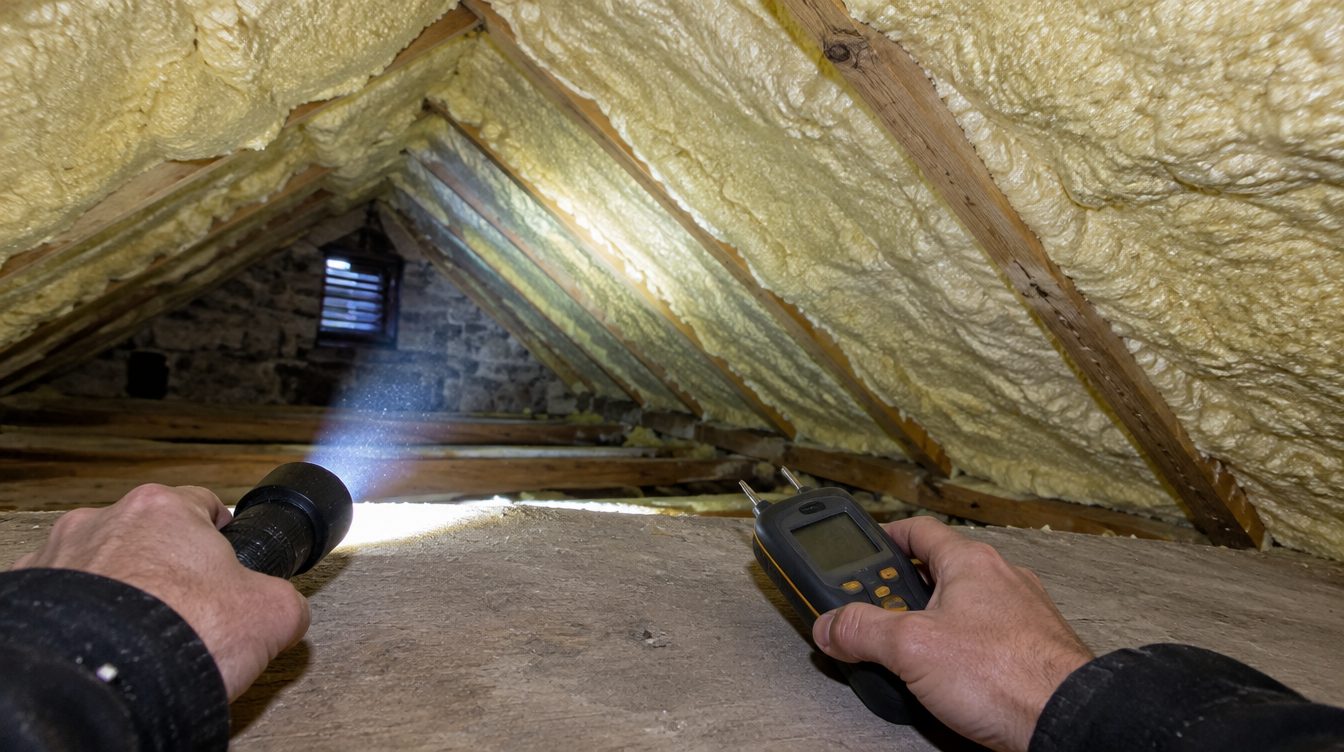
Spray foam is a liquid insulation that is sprayed through a gun and expands to form a layer. In homes it is most often applied to the underside of the roof covering, between and over the rafters, rather than laid on the loft floor like traditional mineral wool.
That changes how the roof works. A traditional loft is a “cold roof”, with insulation at ceiling level and a ventilated, unheated space above. Spraying foam onto the rafters creates a “warm roof”, where the insulation follows the slope of the roof and the loft space becomes part of the heated envelope. The RICS consumer guide on spray foam insulation describes this as a serious modification that should not be undertaken lightly.
Open cell and closed cell spray foam
There are two main types, and the difference matters when a surveyor looks at your roof.
| Feature | Open cell spray foam | Closed cell spray foam |
|---|---|---|
| Texture once set | Soft, spongy and porous | Rigid, dense and solid |
| How it handles moisture | Lets some water vapour pass through | Acts as a barrier to air and moisture |
| Why it was often used | Cheaper, sold mainly for insulation | Sometimes sold to “hold” loose slates or tiles in place |
| Main concern for surveyors | Moisture and condensation passing into the foam and timbers if there is no suitable vapour control | Timbers sealed in, so any decay or leak can go unseen, and the foam is very hard to remove cleanly |
| Removal | Generally easier to cut away | Generally harder, with a greater risk of damage to timbers and roof covering |
Neither type is automatically a problem if it was specified correctly, installed properly and backed by paperwork. The trouble is that much spray foam was sold on the doorstep, without a proper roof survey and without the documents lenders now ask to see.
Why are lenders and surveyors wary of spray foam?
Lenders lend against the value of the property, so they care about anything that could cause hidden damage. Spray foam raises several concerns at once.
- The roof timbers cannot be inspected. Once the rafters are covered, a surveyor cannot see whether they are sound. RICS points out that covered timber cannot be fully seen or inspected.
- Leaks can go unnoticed. If a slate slips or flashing fails, water can track behind the foam. RICS warns that you may not notice a leak behind some types of foam, which can lead to rotting timber.
- Condensation and timber decay. Poorly installed foam can cause uncontrolled condensation or trap moisture against the timber. The Property Care Association lists condensation, timber rot, mould and corrosion of metal fixings among the problems linked to poor installation.
- The roof covering itself. Foam stuck to the underside of slates or tiles can make future roof repairs harder and more expensive, because roofers cannot simply lift and relay slates.
- Fire performance. RICS notes that polyurethane spray foam is a combustible material, and suggests homeowners check the position with their insurer.
The scale of the problem is not trivial. A Property Care Association survey reported in 2025 found issues in 35% of homes with spray foam, and in 27% of cases the foam needed to be removed or the roof replaced. Citizens Advice reported in June 2025 that around one in three people with spray foam in their loft said they had experienced problems.
Good to know: Correctly installed foam is not automatically a defect. The concern for lenders is uncertainty. Without evidence of how the foam was specified and fitted, and without being able to see the timbers, a surveyor cannot confirm that the roof is sound.
What does RICS and the wider industry say about spray foam?
RICS published its consumer guide in March 2023. Its key messages are that homeowners should get independent advice before installing spray foam, should never accept cold calls offering it, and should keep every document relating to the work. That includes the contract, any calculations, records of the roof condition before installation, the guarantee and any independent product certificates such as a BBA or Kiwa certificate.
RICS also makes clear that the presence of spray foam can affect a surveyor’s opinion of value, that a surveyor may ask for an independent specialist report, and that surveyors working for a lender must follow that lender’s instructions and policies.
The inspection protocol and later industry work
Because lenders and surveyors were reaching very different conclusions, the Property Care Association and the Residential Property Surveyors Association set up a working group that brought together surveying bodies, lenders, product certification bodies, insurers and the spray foam industry. In March 2023 it published an inspection protocol for spray foam on pitched roofs. The aim was to judge each roof on its condition and risk factors, rather than refusing a property simply because foam is present.
Since then, the work has continued:
- In 2024 the Property Care Association set up a register of people trained to assess spray foam installations.
- In April 2025 it published consumer guidance for homeowners worried about the foam in their roof, including a checklist of warning signs.
- In 2025 UK Finance, which represents mortgage lenders, said spray foam can cause issues in properties and that there is often a lack of certification around its installation. The Property Care Association said it would keep working with UK Finance and the HomeOwners Alliance on support for affected homeowners.
- In August 2026 the Property Care Association created a membership category for spray foam removal contractors, with competency requirements, independent auditing and compliance monitoring, and began consulting on a wider framework.
These steps have not produced a single standard that every lender accepts, and lender policies still differ.
What will a Scottish Home Report say about spray foam?
When you sell in Scotland you normally need a Home Report, which includes a Single Survey, an Energy Report and a property questionnaire. Our guide to what a Home Report is and why you need one explains the parts in detail.
The surveyor carries out a visual inspection and looks into the roof space where it is safely accessible. If they find spray foam on the rafters, they will usually record it, explain that the timbers and underside of the roof covering could not be inspected, and recommend further investigation by a suitably qualified specialist. Depending on what they see, that comment may sit alongside a category 2 or category 3 rating for the roof space or roof covering.
How spray foam can affect the valuation
The Single Survey includes a valuation that the buyer’s lender relies on. A surveyor may reduce the figure to reflect the foam, add a comment that lenders may require a specialist report, or say that the property may not be suitable security for some lenders. A buyer reading that will often want a lower price, or may simply walk away. If your Home Report flags serious problems, our article on what happens if your Home Report highlights major problems sets out your options.
You must also be honest. Do not try to hide the foam or the survey comments. Our guide on whether you have to disclose every fault explains how disclosure works under Scots law, and the property questionnaire asks about guarantees and work carried out at the property.
Will a buyer’s lender refuse a mortgage on a house with spray foam?
Some will and some will not. In broad terms, lender approaches tend to fall into three groups:
- Lenders that decline any property with spray foam in the roof.
- Lenders that consider each case on its merits, usually only with a satisfactory independent inspection report and evidence of the product, installer and guarantee.
- Lenders that are more relaxed where the foam is a recognised product, fitted with proper ventilation and paperwork.
Policies change, and the same property can be declined by one lender and accepted by another. Many buyers only discover their lender’s position after the valuation, once an offer has been accepted. If that happens, our guide on what happens if your buyer’s mortgage application is declined explains where you stand, and our article on a house sale falling through in Scotland covers the next steps.
Watch out: An accepted offer is not binding until missives are concluded. A buyer whose lender refuses because of spray foam can usually withdraw without penalty, so it pays to raise the foam early and make sure buyers know what the Home Report says.
How does spray foam affect remortgaging and equity release?
The same lender concerns apply when you remortgage. If you switch to a new lender, a valuer will look at the property again, and a lender that does not accept spray foam may decline. Staying with your existing lender on a product transfer often avoids a fresh valuation, but that is not guaranteed and depends on the lender.
Equity release is a particular problem, because lifetime mortgages run for many years and lenders are wary of hidden defects. Industry reports in 2025 described the equity release market as effectively closed to homes with spray foam in the roof. That leaves many older owners, often the targets of doorstep selling, considering a sale instead.
Should I remove the spray foam before selling?
Removal can help, but it is not always the answer.
What removal involves
Removal usually means cutting and scraping the foam away from the rafters and the underside of the roof covering, bagging it and taking it away. Open cell foam is generally easier to remove than closed cell. RICS warns that removal could potentially damage the existing structure, and once the timbers are exposed a specialist will need to check for decay. If slates were held in place by the foam, the roof covering may need repairs, and in some cases a full re-roof.
What it costs
Costs vary with the size of the roof, the type of foam and what is found underneath. Advice Direct Scotland reported in 2024 that removal typically averages around £3,200 for a three bedroom detached house. That is only for removing the foam. Citizens Advice has reported that some affected homeowners face costs of more than £50,000 where removal leads to major roof repairs or replacement.
| Option | What it involves | Likely effect on a sale |
|---|---|---|
| Leave the foam and sell as it is | No work, disclose the foam and survey comments | Fewer mortgage buyers, likely lower price, cash buyers still possible |
| Commission an independent inspection report | A specialist assesses the roof using the industry protocol | Some lenders may then proceed, but the report can also uncover problems |
| Remove the foam | Specialist removal, timber check, possible roof repairs | Wider lender appeal if well documented, but cost and disruption can be significant |
| Remove the foam and re-roof | Full replacement of the roof covering and any decayed timber | Usually resolves lender concerns, but often the most expensive route |
| Sell to a cash buyer | No mortgage valuation needed | Speed and certainty, usually at a price below full open market value |
Does removal fix the problem?
Removal can make a property mortgageable again, but only if it is done properly and evidenced. Lenders and surveyors will want to see a report from a reputable contractor confirming what was removed, the condition of the timbers and any repairs carried out. A poor removal job that leaves residue on the timbers or damages the roof can leave you no better off. Removal will also take away the insulation, so you may need to insulate the loft in the conventional way afterwards, which affects your Energy Performance Certificate.
Watch out: Advice Direct Scotland and Trading Standards Scotland have warned about rogue removal firms that cold call spray foam owners, sometimes falsely claiming links to Trading Standards. Never agree to removal on the doorstep, never pay upfront, and get independent advice and several quotes first.
What if the spray foam was mis-sold or grant funded?
Many Scottish homeowners were sold spray foam by cold callers who claimed the roof had damp or mould that only foam could fix. Trading Standards Scotland reported a 42% rise in spray foam incidents in 2023, costing Scottish homeowners around £500,000. If you think you were misled, you may have a complaint.
Where to complain
- The installer and its guarantee provider. Start with the company that fitted the foam. If it has ceased trading, check whether the guarantee was insurance backed and contact the guarantee provider or the trade body the installer belonged to.
- Advice Direct Scotland. The free consumeradvice.scot service can advise on your rights under consumer law and pass cases to Trading Standards.
- Trading Standards. Your local council’s Trading Standards team deals with misleading and aggressive selling under the Consumer Protection from Unfair Trading Regulations 2008.
- Your finance provider and the Financial Ombudsman Service. If you paid using a credit card or a finance agreement arranged by the installer, the lender may share responsibility for misrepresentation or breach of contract under section 75 of the Consumer Credit Act 1974, for items costing over £100 and up to £30,000. If the finance company rejects your complaint, you can take it to the Financial Ombudsman Service.
Grant funded installations and Home Energy Scotland
Some insulation in Scotland has been funded through Scottish Government backed grants and loans administered by Home Energy Scotland, with conditions such as using a TrustMark registered installer for certain measures. If public money paid for your foam, ask Home Energy Scotland what records exist. That paperwork can help a surveyor, a lender or a complaint.
Citizens Advice published a report on spray foam mis-selling in June 2025, A Foamidable Challenge, calling for a mandatory quality scheme and a single ombudsman for home energy upgrades. Speaking to a solicitor or a free advice service before you sell can help you keep any claim alive.
Did I need a building warrant for spray foam?
Building standards in Scotland come from the Building (Scotland) Regulations 2004 and the Scottish technical handbooks, not English building regulations. Whether a warrant was needed depends on the work done, so ask your local authority building standards team if you are unsure. Our guide to selling a house with an extension and no building warrant explains how missing warrants are usually handled in Scottish sales.
How does spray foam compare with other issues that put lenders off?
Spray foam belongs to a wider group of issues that are awkward for mortgage lenders rather than for the people living in the house. See our guides on selling a house with Japanese knotweed, selling a property built with RAAC and selling a house classed as non-standard construction. Where the foam has led to condensation or rot, our article on selling a house with damp or structural issues is also relevant.
How can a cash buyer help if your house has spray foam?
The main obstacle to selling a house with spray foam is the buyer’s mortgage. A cash buyer does not need a lender’s approval or a mortgage valuation, so the foam does not stop the purchase. That can make a cash sale a realistic route if:
- Your Home Report has already flagged the foam and buyers are backing away.
- A previous sale has fallen through because a lender declined.
- You cannot afford removal, or removal has uncovered roof damage.
- You were hoping for equity release or a remortgage and have been refused.
- You need certainty over timing, for example because of a move, a care home, a divorce or an executry.
A cash buyer can buy the house as seen, and you can agree the date of entry that suits you. You can read more about how our process works and about selling a hard to sell property in Scotland. We buy across the country, from Glasgow to the Falkirk area and beyond.
When a cash sale may not suit you
A cash sale is not right for everyone. Cash buyers usually offer below full open market value, reflecting the risk and cost they take on, as our guide on why cash buyers pay less explains. If you have time, money for removal and clear paperwork, you may achieve more on the open market. Compare both routes, and speak to your solicitor or a financial adviser before deciding.
Frequently asked questions
Do I have to tell buyers about spray foam in my loft?
Yes, you should be open about it. Your Home Report surveyor is likely to record it anyway, and hiding a known issue can give the buyer grounds for a claim. Share any guarantee, certificate and inspection report you have.
Is spray foam insulation illegal in Scotland?
No. Spray foam is a legal product, and a properly specified and installed system can perform well. The issues are poor installation, lack of paperwork and the cautious approach many lenders take.
Will all lenders refuse a house with spray foam?
No. Some lenders refuse outright, others consider each case with a satisfactory independent report, and policies change. A whole of market mortgage broker can tell your buyer which lenders are currently willing to look at it.
Can I get a specialist report before I sell?
Yes. An independent inspection by someone trained in the industry protocol can tell you the condition of the roof and what a lender is likely to want. Choose someone with no link to a removal company, so the advice is impartial.
Does removing spray foam guarantee my house will sell?
No. Removal can make the property acceptable to more lenders if it is done properly and documented, but it can also reveal timber decay or roof damage that needs further work. Get independent advice before committing.
Will a cash buyer still want to see the Home Report?
Usually a cash buyer will look at the Home Report and the property, but it does not need a lender’s approval. That means the foam affects the price rather than whether the sale can go ahead.
Struggling to sell because of spray foam?
Get a free, no obligation cash offer for your home as it is, with no mortgage valuation and no need to remove the foam first.
